
A lottery where everyone wins.
That’s the Lotto5 pitch. You get a free pre-filled ticket. The Lotto5 AI algorithm runs the numbers. And no matter what comes up in the live draw, your Lotto5 ticket pays out — somewhere between $500 and $5,000, every single month, for a full year.
There’s just one thing you need to do first: pay a small “analysis fee” to verify your ticket.
If that sentence made you pause, trust your instincts. Because what Lotto5 has constructed here is one of the most clearly documented fraud structures in existence — dressed up in AI branding, a charitable backstory, and a live draw that makes the whole thing feel legitimate before you’ve had a chance to think it through.
This Lotto5 review will walk through exactly how it works, why every element of it is invented, and what the “analysis fee” actually represents.
First — This Is Important
If you’re tired of scams like Lotto5 and just want a real way to make money online, see my no.1 recommendation below. It’s the best system I’ve found after 15+ years testing online income programs — and it’s nothing like this.
👉 My #1 Recommendation for Building a Real Online Income
Key Takeaways
- Lotto5 claims to be an AI-powered lottery where every participant is guaranteed to win between $500 and $5,000 per month for 12 months
- The core mechanic — “pay a fee to release your winnings” — is the defining structure of advance fee fraud, one of the oldest documented scam categories
- The “Citizens Emergency Foundation” and its president “Lewis Carter” do not exist — no public records, court filings, or registrations of any kind
- The $17 million lawsuit against polluting corporations is entirely fabricated — no such case exists in any searchable legal database
- The AI algorithm described cannot exist as claimed: lottery outcomes are random by mathematical design, and no algorithm can guarantee a payout for every participant
- Testimonials from “John from Milwaukee,” “Karen Davis,” “Raymond the retired fisherman,” and others are fabricated personas using stock imagery or AI-generated identities
- The psychological support programme for “big winners” is an immersion technique designed to reinforce the belief that the money is real before the fee is paid
- Manufactured urgency — “once the live draw ends, you can’t rejoin” — is a pressure tactic to prevent rational evaluation
What Is Lotto5?
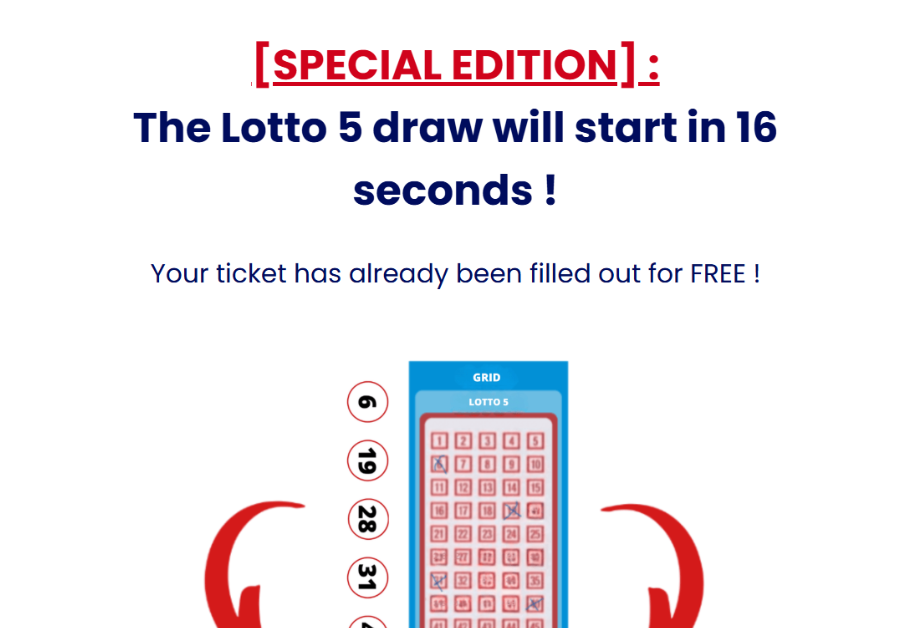
Lotto5 presents itself as the world’s first AI-powered lottery platform. The sales narrative goes like this: a foundation called the Citizens Emergency Foundation won a $17 million lawsuit against corporations that poisoned communities with air pollution. Rather than keep the money, the foundation’s president Lewis Carter chose to distribute it to ordinary people through a fair algorithmic lottery system — Lotto5.
Every participant receives a free pre-filled ticket. A live draw takes place. The Lotto5 AI analyses thousands of data points and calculates your individual payout — somewhere between $500 and $5,000. Critically, every participant wins something. There are no losing tickets. The AI guarantees it.
Before you can withdraw, your ticket must be “analysed” for authenticity. This requires a small one-time fee. Pay the fee, and your winnings are released. The same amount arrives monthly for a year.
Each element of this story is constructed to make one thing feel reasonable: handing over money in exchange for winnings you’ve already been told are yours.
The Advance Fee Structure — Why This Is the Oldest Scam in the Book
Before examining any of the specific claims Lotto5 makes, it’s worth naming the underlying structure directly.
The defining characteristic of advance fee fraud — sometimes called a 419 scam or a “fee to release funds” scam — is this: you are told that a sum of money is waiting for you, and that releasing it requires you to pay a fee upfront. The fee is never returned. The funds never existed.
This structure has been documented for over a century. It was the basis of Spanish Prisoner letters in the 1800s. It evolved into Nigerian Prince emails in the 1990s. It has been dressed in hundreds of different costumes — inheritances, prize draws, government surplus funds, legal settlements — but the mechanism is always identical.
Lotto5 is that mechanism with AI branding applied.
The “analysis fee” to verify your ticket is the advance payment. The “$4,726 per month for one year” is the promised funds. The Citizens Emergency Foundation lawsuit is the invented source of legitimacy. Every other element — the live draw, the AI algorithm, the testimonials, the counselling programme — exists to make the fee feel like a reasonable final step rather than the only step that matters to the people running this.
We’ve seen similar constructions in Lotto Cash Bot 2.0, which used an invented “Federal Disbursement Protocol” and a fabricated $27 million blocked jackpot. The costume is different. The structure is identical.
The Citizens Emergency Foundation — Does It Exist?
The source of Lotto5’s claimed funds is a $17 million lawsuit won by the Citizens Emergency Foundation against three corporations responsible for air pollution. The foundation’s president, Lewis Carter, appears in the live stream to explain the backstory and validate the system.
The Citizens Emergency Foundation does not exist.
There is no registered charity, nonprofit, or foundation under this name in any searchable public database. No IRS 990 filing. No state charity registration. No court records for a $17 million environmental lawsuit associated with this organisation or this name. Lewis Carter has no verifiable professional profile, no LinkedIn presence, no media coverage consistent with leading a foundation that won a landmark $17 million environmental case.
This pattern of an invented foundation providing the moral legitimacy for a money distribution scheme is something we’ve documented before. Lotto Cash Bot 2.0 used “Peter Ratcliffe” and a fabricated DHS blocked jackpot. Emergency Cash Platform used a fictitious “Gold Surplus Act of 2026.” The function is the same: establish a source for the money that sounds official, institutional, and verifiable — but cannot actually be verified, because it doesn’t exist.
The AI Guarantee — Why It’s Mathematically Impossible
Lotto5 claims its AI algorithm “analyses thousands of data points” and guarantees every participant a winning payout between $500 and $5,000.
This claim fails on the most basic level of how lotteries work.
Legitimate lotteries generate outcomes through certified random number generators or physical draw mechanisms specifically designed to ensure each outcome is statistically independent of every other outcome. No pattern. No predictability. No influence from prior draws. This randomness is not a design flaw — it is the legal and mathematical requirement for a lottery to function as a lottery.
No AI system, regardless of processing power or data access, can guarantee a specific payout for every participant in a genuinely random draw. The moment every participant is guaranteed to win, the draw isn’t a lottery — it’s a guaranteed payment programme. And a guaranteed payment programme requires a guaranteed source of funds.
There is no such fund. The Citizens Emergency Foundation doesn’t exist. The $17 million lawsuit is fabricated. The AI “algorithm” is a fictional mechanism invented to explain why a mathematically impossible outcome — everyone wins — somehow happens anyway.
What the AI framing actually does is exploit the current cultural moment around artificial intelligence. Many people understand that AI can do remarkable things, and are uncertain enough about its limits to accept claims that would otherwise trigger immediate scepticism. “The AI guarantees your payout” sounds technical and modern. It means nothing.
The Testimonials
The source material presents a cast of winners whose stories are designed to cover different demographics and emotional triggers:
John, 38, from Milwaukee — used winnings to take neighbourhood kids to an amusement park. Community-minded, relatable.
Karen Davis, 51, from Dallas — bought a Honda Civic. Modest, specific, believable.
Miguel Rodriguez, a locksmith — sent money to his mother in Mexico. Family loyalty, immigrant narrative.
Raymond, a retired fisherman — receiving $4,431/month, fulfilling his wife’s lifelong dream trip to New York. Retirement aspiration.
Kelly, a pregnant hairstylist — receiving $3,256/month, moved to a bigger house, stopped worrying about money. Young family, financial anxiety.
The specificity is intentional. Exact figures ($4,431, $3,256, $3,764). Named cities. Occupations. Personal details. All of these exist to make invented characters feel like real people you could look up if you wanted to.
None of these individuals are verifiable. No social media profiles matching these names and stories. No media coverage. No corroborating evidence of any kind. This is the same fabricated testimonial structure we identified in One Click Cash Bot, G-Labs 95, and every other product in this review catalogue — personas assembled from stock imagery or AI generation, given enough biographical detail to feel human.
The Psychological Counselling Programme
One element of the Lotto5 sales narrative deserves specific attention: the mention that the platform offers “a psychological support program for big winners” because receiving thousands monthly can feel “overwhelming.”
This is not a customer welfare initiative.
It is an immersion technique — a device that plants you mentally inside the experience of being a winner before you’ve paid anything. By the time you’re reading about counselling for winners, your brain has already started modelling what receiving $4,726 monthly would feel like. The emotional state being cultivated is one of someone who has already won and is now considering how to manage it.
We identified this exact technique in Lotto Cash Bot 2.0, which used the same counselling language. It is a calculated feature, not an afterthought.
The Urgency Mechanics
“Don’t wait too long — because tickets and draws are limited. Every minute counts, and once the live draw ends, you can’t rejoin.”
Manufactured scarcity. The live draw doesn’t have a finite audience that closes. The same pressure language appears on every visit to the page, for every prospective mark. The purpose is to prevent you from stepping away long enough to search for independent reviews, ask someone you trust, or simply sleep on the decision.
We’ve documented this compression tactic across DP5 AI (38 spots remaining), Automatic Money App 4.0 (50 spots per day), and Lotto Cash Bot 2.0 (30-minute countdown). It is a standard feature of products that cannot survive scrutiny.
What Happens When You Pay the Fee
Based on the documented pattern of identical scam structures, here is what actually happens when you pay the “analysis fee”:
You receive nothing. Or you receive a low-value digital product — a PDF, a guide, something with nominal existence — that provides no pathway to the winnings described. The “winnings” were never held anywhere, because there is no Citizens Emergency Foundation, no $17 million settlement, and no AI algorithm distributing funds.
If you attempt to contact support, you may find yourself directed toward a second fee — an “additional verification” or “processing charge” — before your funds can be released. This is a common escalation pattern in advance fee fraud: each payment unlocks a new reason why the promised funds haven’t yet arrived.
The 60-day refund guarantee is listed in the sales material. In practice, refund guarantees on products like this are frequently unreachable — support channels that don’t respond, payment processors that make claims difficult to pursue. As we noted in the Inbox Money Vault review, Lotto5’s sales material itself contradicts its refund terms in different sections, which is a red flag for a guarantee that exists on paper only.
Lotto5 vs. Legitimate Lottery Products
It’s worth drawing a clear distinction between Lotto5 and legitimate lottery-adjacent products, because the category isn’t entirely fraudulent.
| Feature | Lotto5 | Legitimate Lottery Tools |
|---|---|---|
| Guaranteed wins | Claims every participant wins | No legitimate tool can guarantee wins |
| Fee structure | Pay fee to release pre-existing winnings | No winnings until you buy a ticket through an official lottery |
| AI claims | AI guarantees specific payouts | AI can suggest numbers; outcomes remain random |
| Founder/organisation | Unverifiable (Citizens Emergency Foundation, Lewis Carter) | Transparent company, registered entity |
| Testimonials | Unverifiable personas | Mixed, but tied to verifiable platform |
| Legal standing | No registration, no regulatory oversight | Operates within lottery laws |
| What you actually get | Nothing of value | Number suggestions; no guaranteed results |
The fundamental difference is this: legitimate lottery tools are honest about the fact that they cannot guarantee wins, because lottery outcomes are random. Lotto5 claims to have solved randomness. That claim is the scam.
Pros and Cons
| Pros | Cons |
|---|---|
| None that are substantive | Advance fee fraud structure — the defining feature of this scam category |
| Citizens Emergency Foundation does not exist — no registration, no legal records | |
| Lewis Carter is an unverifiable persona | |
| $17 million corporate pollution lawsuit is entirely fabricated | |
| AI cannot guarantee lottery winnings — mathematically impossible | |
| All named winners are unverifiable — fabricated personas | |
| Psychological counselling language is an immersion technique, not a welfare programme | |
| Manufactured urgency prevents rational decision-making | |
| 60-day refund guarantee unreliable in practice | |
| Identical structure to Lotto Cash Bot 2.0 and documented advance fee fraud playbook |
Frequently Asked Questions
Is Lotto5 a scam?
Yes. The product uses an invented charitable foundation, a fabricated lawsuit, an impossible AI guarantee, and fabricated testimonials to make a single outcome feel reasonable: paying an “analysis fee” to release winnings that do not exist. This is advance fee fraud.
Can an AI algorithm guarantee lottery winnings for every participant?
No. Lottery outcomes are random by mathematical and legal design. No AI system can guarantee a specific payout for every participant in a random draw. The claim is not technically impressive — it is impossible.
Does the Citizens Emergency Foundation exist?
No. There is no registered charity, nonprofit, or foundation under this name. No IRS filing, no state registration, no court records for a $17 million pollution lawsuit associated with this organisation. Lewis Carter has no verifiable public profile.
What is the “analysis fee” actually for?
It is the advance payment in an advance fee fraud scheme. You are told your winnings are being held and the fee releases them. The winnings do not exist.
Are the testimonials from real people?
None of the named winners — John from Milwaukee, Karen Davis, Miguel Rodriguez, Raymond, Kelly — are verifiable individuals. No public profiles, no media coverage, no corroborating evidence.
What happens after you pay?
Based on the pattern of identical scam structures, you receive nothing of value. Additional fees may be requested. Refunds are typically inaccessible in practice despite written guarantees.
Why is this different from a regular lottery scam?
The AI framing and the charitable backstory are newer packaging. The underlying structure — pay a fee to release winnings you’ve been told are yours — is identical to advance fee fraud schemes that have existed for over a century.
Final Verdict
Lotto5 is advance fee fraud.
That phrase sounds stark, but it’s the accurate description. Every element of the product — the live draw, the AI algorithm, the Citizens Emergency Foundation, Lewis Carter, the named winners, the psychological counselling, the urgency countdown — exists to make a single request feel legitimate: pay a small fee before you can access money that is already yours.
The money is not yours. It has never been held anywhere. There is no foundation. There is no lawsuit. There is no AI algorithm that can guarantee a lottery payout for every participant, because lottery outcomes are random by design and such a guarantee is mathematically impossible.
What makes Lotto5 effective at what it does is the layering. The charitable backstory provides moral legitimacy. The AI framing provides technological credibility. The live draw provides social proof. The testimonials provide human relatability. The counselling programme plants you inside the winner experience before you’ve paid. And the urgency closes the window before you can think clearly.
Every layer is fabricated. The structure underneath all of it is one of the oldest fraud mechanisms in documented history.
If you’re looking for a legitimate way to build income online, it starts with understanding what real work actually involves — not a lottery that guarantees everyone wins.
👉 Here’s what I personally recommend instead — a legitimate way to build real online income

Mark is the founder of MarksInsights and has spent 15+ years testing online business programs and tools. He focuses on honest, experience-based reviews that help people avoid scams and find real, sustainable ways to make money online.