
Hey, it’s Mark from MarksInsights.
If you’re researching AI Agent Bootcamp, there’s a good chance you’re not just curious about AI, you’re wondering whether building AI agents is a real way to make money, or just another technically impressive idea that looks better on YouTube than it does in practice.
AI Agent Bootcamp, created by Tina Huang, promises to teach you how to build multi-agent AI systems in just 28 days. The pitch is polished, the credentials look strong, and the idea of selling AI automation to businesses sounds extremely attractive in 2026.
But attractive ideas don’t always translate into reliable income models.
In this review, I’ll break down what AI Agent Bootcamp actually teaches, who it realistically works for, where expectations start to drift from reality, and why most beginners struggle to turn this into consistent revenue.
Before I start
If your goal is real online income — something you understand, control, and can grow over time, this is the model I personally use and recommend after 15+ years of testing almost everything in this space:
👉 See my No.1 recommendation here
Key Takeaways (Read This First)
-
AI Agent Bootcamp teaches how to build multi-agent AI systems, not how to consistently sell them
-
The technical depth is real, but the income model is unclear for beginners
-
Multi-agent systems are complex, fragile, and require ongoing maintenance
-
Most real buyers are mid-market or enterprise, not small businesses
-
One or two success stories don’t reflect the average student outcome
-
I do not recommend this as a beginner income model
👉 See my No.1 recommendation here
What AI Agent Bootcamp Claims to Be
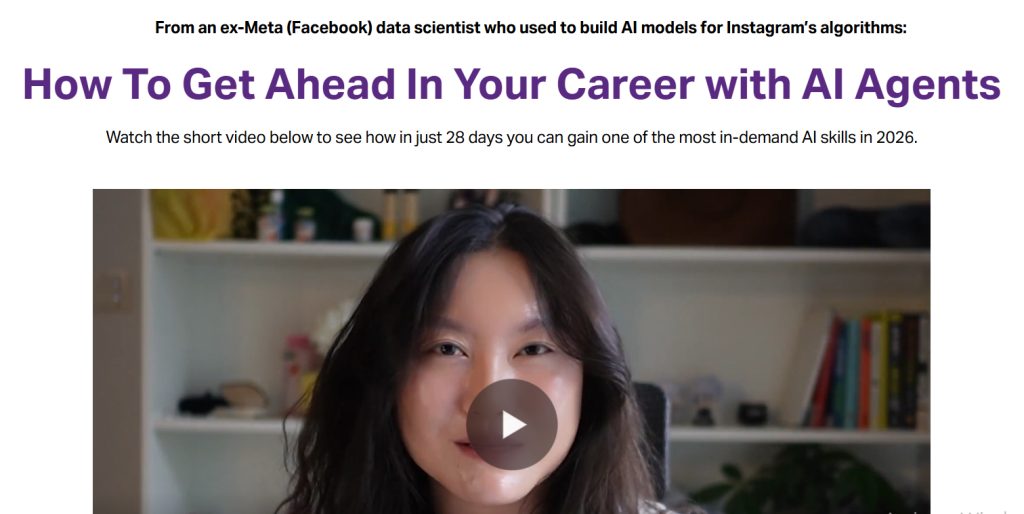
AI Agent Bootcamp is a 28-day intensive program that teaches students how to design and deploy multi-agent AI systems, workflows where multiple AI agents collaborate to complete complex tasks.
Instead of a single chatbot doing everything, these systems split responsibilities across agents. One agent might research, another summarises, another makes decisions, and another triggers tools or APIs.
The course is delivered through Tina Huang’s company, Lonely Octopus, and includes structured lessons, live components, and a strong community emphasis. There’s also a VIP tier that adds one-to-one coaching.
On paper, it sounds like a fast track into the AI economy.
The question is whether technical capability equals commercial viability.
Who Tina Huang Is (And Why Her Credibility Is Real)
Unlike many AI course creators, Tina Huang’s background is legitimate.
She has formal training in pharmacology and computer science, experience in bioinformatics and machine learning, and worked at Meta on AI systems related to Oculus and Instagram. She’s also built a large educational presence through Lonely Octopus and YouTube.
This matters because the technical instruction itself is not the issue here. Tina knows the subject matter, and students generally agree that the explanations are clear and well-structured.
The problem isn’t what is taught — it’s what people assume happens next.
How the Multi-Agent Systems Model Actually Works
Inside the course, students learn how to design AI systems where multiple agents interact based on defined roles.
Each agent typically has:
-
A specific task
-
A defined output format
-
An underlying language model
-
Access to tools like APIs, search, calendars, or databases
Agents can work sequentially, hierarchically, in parallel, or asynchronously. These setups are powerful for complex workflows like research pipelines, internal reporting, or long-running monitoring tasks.
But power comes with complexity.
These systems require:
-
Careful prompt design
-
Ongoing debugging
-
Monitoring after deployment
-
Manual fixes when APIs or models change
This isn’t “set and forget” automation. It’s closer to software engineering with AI components.
The Reality of Selling Multi-Agent AI Systems
Here’s where most promotional content glosses over reality.
Multi-agent systems are not something most small businesses buy.
The actual buyers tend to be:
-
Mid-sized companies with internal operations teams
-
Enterprises with complex workflows
-
Organisations that already understand AI limitations
These buyers expect:
-
Security reviews
-
Long demos
-
Customisation
-
Ongoing support contracts
That creates a huge gap for beginners.
You’re not selling a simple service. You’re selling bespoke systems with long sales cycles, technical risk, and ongoing responsibility.
The Roque Pagan $10K Case Study (And Why It’s Misleading)
One frequently referenced success story is Roque Pagan, who reportedly sold a $10,000 AI agent system after attending the bootcamp.
This happened at a major expo, to a client with a clear, complex use case, and resulted in a custom solution involving scheduling, research, and reporting.
That’s impressive — but it’s also not representative.
With hundreds of students enrolled, there are very few documented cases showing:
-
A real deployment
-
A real buyer
-
A real revenue number
One win doesn’t define a repeatable model.
The 28-Day “Expert” Claim
AI Agent Bootcamp suggests that you can become proficient in building AI agent systems in 28 days, even without prior coding experience.
Technically, you can build something in that timeframe.
But being able to:
-
Architect reliable systems
-
Diagnose failures
-
Maintain them over time
-
Support clients
…takes far longer.
No-code tools lower the barrier, but they don’t remove the need for technical thinking. One API change can break an entire workflow, and someone has to fix it — usually you.
Pricing, Refunds, and Risk
AI Agent Bootcamp costs $997, with a VIP tier at $4,997.
There’s a short refund window, which means you’re expected to quickly decide whether the model suits you — before you’ve had time to test it in the real world.
This isn’t unusual in the education space, but it does increase risk for beginners who are still figuring out what they actually want to build.
Why Most Students Don’t Earn Consistently
Even if you master the technical side, income still depends on:
-
Market demand
-
Clear positioning
-
Sales ability
-
Client trust
AI Agent Bootcamp does not focus heavily on:
-
Market validation
-
Sales pipelines
-
Pricing strategy
-
Long-term client retention
As a result, most systems end up as one-off builds rather than recurring income assets.
That’s a hard way to scale.
A Better Alternative (What Actually Works Long-Term)
If AI Agent Bootcamp appealed to you, it’s probably because you want:
-
High-value skills
-
Modern technology
-
A future-proof income model
Those are sensible goals.
But complexity is not the same as leverage.
The alternative I recommend focuses on owning simple digital assets that solve obvious problems for businesses that already pay for results.
Instead of building fragile, custom systems, you control assets that generate demand continuously.
👉 See my No.1 recommendation here
Final Verdict: Is AI Agent Bootcamp Worth It?
AI Agent Bootcamp is technically solid, but it does not teach a beginner-friendly or consistent income model.
If you already:
-
Have technical aptitude
-
Enjoy debugging systems
-
Want to work with enterprise clients
…it might fit.
For everyone else, it’s far more likely to become an impressive skillset without a clear monetisation path.
Complex systems don’t automatically create simple income.
FAQs
Is AI Agent Bootcamp a scam?
No. The training is real, and Tina Huang is credible. The issue is income expectations, not legitimacy.
Can beginners succeed with this?
Only with significant additional effort in sales, troubleshooting, and client management.
Is no-code enough long term?
Not really. Most real deployments eventually require custom logic or coding.
Is there recurring income potential?
Only if you retain clients and maintain systems — which means ongoing work.
Would I recommend this as a first online business?
No. The learning curve and client expectations are too high for most beginners.
If you want something simpler, more predictable, and easier to scale, this is the approach I’d point you to instead:
👉 See my No.1 recommendation here

Mark is the founder of MarksInsights and has spent 15+ years testing online business programs and tools. He focuses on honest, experience-based reviews that help people avoid scams and find real, sustainable ways to make money online.