
If you’re researching P&P 500 (sometimes called Profit and Pay 500), you’re probably thinking,
Is this a real opportunity or just another story designed to sound official?
The reason this one grabs attention is obvious. It borrows credibility from the S&P 500, mixes in government-style language, and presents itself as a “profit redistribution system” that supposedly pays ordinary people thousands of dollars per week.
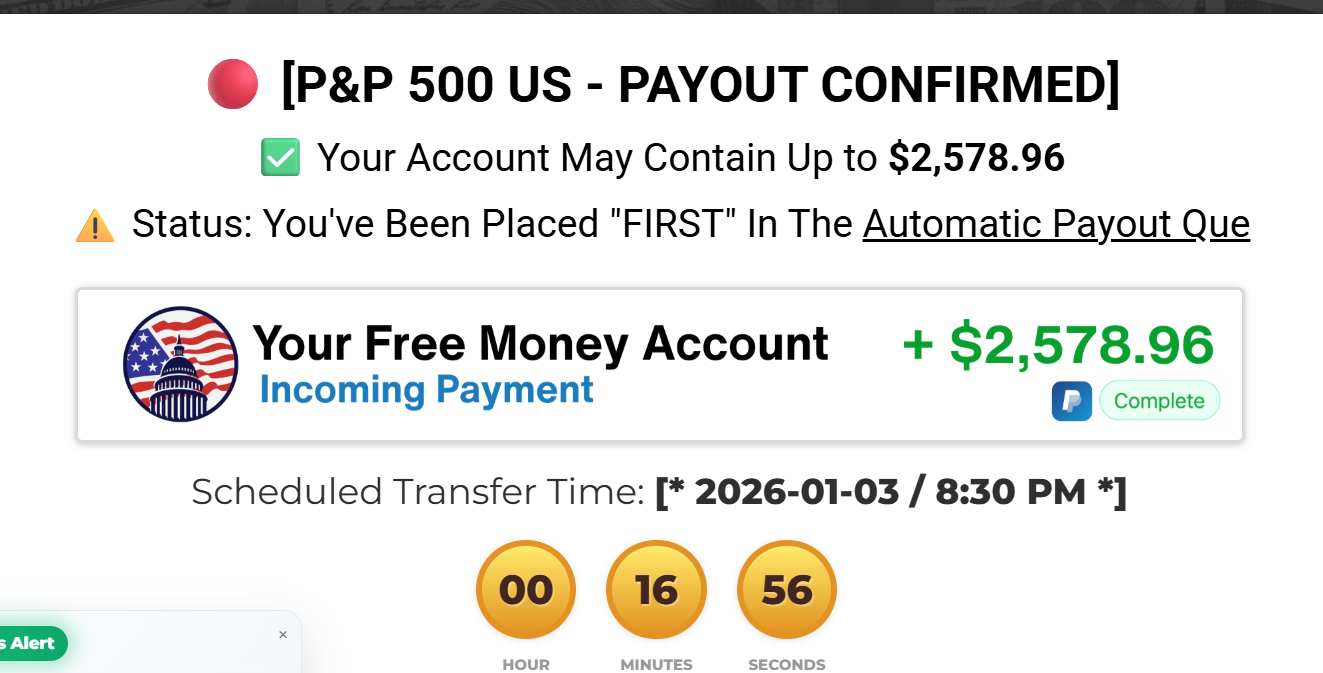
I’ve been reviewing online income systems for 15+ years so I know exactly what to look for, and to be quite honest, as soon as I opened up the link to Profit and Pay 500 I knew it wasn’t legit.
In this review I’ll provide a balanced view on what is really going on here, and give you my verdict.
But First, Why Listen To Me?
 I’m Mark from MarksInsights. Over the past 15+ years, I’ve analysed and tested hundreds of online income systems from real investment platforms to the latest “push-button” offers and everything in between.
That experience makes it very easy to spot what’s real, what’s exaggerated, and what simply doesn’t hold up.
If I were starting from scratch today, there’s only one business model I’d personally focus on — because it’s transparent, asset-based, and proven to work in the real world.
Now let’s look at P&P 500 properly.
Key Takeaways – P&P 500 at a Glance
-
P&P 500 claims to distribute weekly income tied to S&P 500 “profits”
-
The story relies on a fictional government-forced profit redistribution fund
-
No such federal program, ruling, or mechanism exists
-
The named creator and insider backstory cannot be verified
-
The payment figures are oddly precise to create perceived legitimacy
-
The platform follows a familiar low-ticket funnel pattern used in many fabricated income schemes
-
Verdict: P&P 500 (Profit and Pay 500) is not legit. This is a typical get rich quick style program that preys on newbies who want to make money online.
Want something real? 👉 See my No.1 recommendation
What P&P 500 Claims to Be
According to its marketing, P&P 500 stands for Profit and Pay 500. As you can see from the screenshot I took of their sales page, they claim that “your account may contain up to $2,578.96” and you’ve been placed “FIRST” in the “Automatic Payout Que”.
The story goes something like this:
-
The U.S. government invested taxpayer funds into the S&P 500
-
Those investments allegedly generated excess profits
-
A quiet legal decision supposedly forced some profits to be redistributed
-
A private platform (P&P 500) was created to automate payouts
-
Users can receive weekly or monthly income without investing, trading, or managing anything
It’s framed as hands-free, legal, already funded, and pre-approved.
That’s the claim but the reality is far different.
Where the Story Breaks Down
This is where experience matters.
1. Governments Do Not Run Retail Profit Redistribution Platforms
The U.S. government does not operate or outsource platforms that:
-
Distribute stock market profits to individuals
-
Require activation through a sales page
-
Allow withdrawals via PayPal, Cash App, Venmo, crypto, or Western Union
-
Limit access via countdown timers or “weekly slots”
Federal funds don’t move this way. Ever.
When governments invest or manage funds (pensions, reserves, bonds), distributions are handled through formal institutions, not opt-in web platforms using urgency messaging.
This exact mismatch between how real systems operate and how scams are presented is one of the core patterns I break down in my Scam Warnings guide.
2. The S&P 500 Is an Index — Not a Cash Machine
This part is subtle but critical.
The S&P 500 is a market index. It doesn’t generate distributable profits on its own.
Legitimate S&P 500 investing works like this:
-
You invest capital via a regulated fund or ETF
-
Returns come from price appreciation and dividends
-
Payouts depend on capital, timing, and market performance
There is no mechanism where profits are pooled by the government and handed out weekly to unrelated individuals.
That concept does not exist in modern finance.
3. The “Creator” Story Is Unverifiable
P&P 500 attributes its existence to a former insider with elite credentials.
That sounds impressive — until you look for:
-
Regulatory records
-
Employment history
-
Court documents
-
Public filings
-
Media coverage
None exist.
In legitimate finance, paper trails are unavoidable. Silence isn’t privacy — it’s absence.
4. Precise Numbers Are a Psychological Tactic
Weekly figures like $2,758.96 are not projections.
They’re persuasion.
Specific numbers feel calculated and official, even when they’re entirely arbitrary. It’s a common tactic in fabricated income schemes because:
-
Round numbers feel salesy
-
Decimals feel system-generated
Real financial systems don’t behave this way.
The Low Entry Price Isn’t a Positive Signal
The $19.97 activation fee is framed as accessibility.
In reality, this pricing model exists because:
-
It lowers resistance
-
It encourages impulse decisions
-
It scales quickly at volume
No legitimate investment, redistribution, or government-connected system operates on a $19.97 activation model.
Why This Story Keeps Appearing
P&P 500 isn’t unique.
It follows a recycled formula I’ve documented repeatedly:
-
Borrow authority from a trusted institution (government, banks, S&P 500)
-
Invent a hidden mechanism or legal loophole
-
Introduce a friendly insider narrator
-
Add urgency through limited access
-
Keep the price low to avoid scrutiny
When one version burns out, the same script reappears under a new name.
Is P&P 500 Legit?
If by legit we mean:
-
Backed by real institutions
-
Operating within verifiable financial frameworks
-
Capable of delivering what it claims
Then no. There is no evidence of any of this being legitimate.
A More Grounded Perspective on Income
Here’s the part most reviews miss.
People aren’t wrong for wanting:
-
Predictable income
-
Passive or semi-passive systems
-
Something that doesn’t require constant selling
Those goals are reasonable.
The mistake is believing they come from mystery systems instead of real assets.
The model I personally recommend focuses on building assets you control, with transparent economics and no invented stories.
👉 See my No.1 recommendation here
Final Verdict – P&P 500 Review
P&P 500 (Profit and Pay 500) is built on a narrative that sounds plausible until you examine it.
Once you do, the foundation disappears. It’s just another get rich quick scam stealing credibility from elsewhere.
If you’re serious about building income online, forget the get rich quick programs like Profit and Pay 500 and learn how to build a real online business.
If you want to see what I recommend after 15+ years in this industry, see below.
👉 See my No.1 recommendation here
Frequently Asked Questions (FAQ)
Is P&P 500 the same as the S&P 500?
No. P&P 500 has no connection to the S&P 500, S&P Global, or any regulated investment fund. The name is deliberately chosen to borrow credibility from a well-known market index, but there is no financial or legal relationship between the two.
Is P&P 500 backed by the U.S. government?
No. There is no government-backed program, law, settlement, or “profit redistribution fund” linked to P&P 500. Claims about hidden rulings or forced payouts do not exist in any verifiable federal records.
Can the government redistribute S&P 500 profits to individuals?
No. The S&P 500 is an index, not a profit-generating entity. Governments do not collect “excess profits” from stock market indexes and redistribute them to unrelated individuals through private platforms.
Why does P&P 500 show very specific payout numbers?
Specific figures (for example, $2,700+ per week) are a psychological persuasion tactic. Precise numbers feel more legitimate, even when they’re arbitrary. Real investment systems do not produce guaranteed, fixed weekly payouts for unrelated participants.
Who is behind P&P 500?
The individuals or company behind P&P 500 cannot be independently verified. There are no confirmed regulatory filings, public company records, or professional histories linked to the names presented in the marketing materials.
Is P&P 500 an investment?
No. P&P 500 is not a regulated investment, fund, or financial product. It does not provide ownership, shares, dividends, or exposure to the stock market in any legitimate way.
Why do systems like P&P 500 keep appearing?
Because the formula works. Using familiar institutions, vague legal language, low entry prices, and urgency is a proven way to drive impulse purchases. When one version stops converting, the same script is relaunched under a new name.
Can people actually make money with P&P 500?
There is no evidence of real, sustainable payouts from P&P 500. The only consistent revenue in systems like this comes from people paying the upfront “activation” fee.
What’s a safer alternative to schemes like P&P 500?
Focus on asset-based business models with transparent economics — not mystery payouts or loopholes. That means models where you control the asset, understand the revenue source, and aren’t relying on fabricated backstories.
What do you personally recommend instead?
I recommend a model that builds real digital assets, produces predictable cash flow, and doesn’t depend on fake authority or hidden systems.
👉 See my No.1 recommendation here

Mark is the founder of MarksInsights and has spent 15+ years testing online business programs and tools. He focuses on honest, experience-based reviews that help people avoid scams and find real, sustainable ways to make money online.