
 Hey, it’s Mark from MarksInsights.
If you’ve been searching for “Elon Musk $1 Trillion IPO stock” or “Jeff Brown $1 Trillion IPO prediction,” you’ve almost certainly come across this teaser from Brownstone Research.
It’s the one where Jeff Brown says you can “claim your stake in Elon Musk’s fastest-growing private venture before it goes public” – a pitch centred around a potential Starlink / SpaceX IPO and a mysterious device Elon is supposedly producing by the thousands.
The headline claim is bold: that everyday investors could “partner with Elon” ahead of what Jeff calls a possible trillion-dollar IPO — starting with as little as $500.
So in this breakdown, I’ll explain what this teaser is actually about, what you’re really buying, how Jeff Brown typically structures these opportunities, and the risks that don’t get highlighted in the promo.
By the way…
If you actually want something real that works online, this is what I personally recommend after 15+ years of testing everything:
👉 See my No.1 recommendation here
Key Takeaways (If You’re in a Hurry)
- This promotion is not a direct way to click a button and buy Starlink shares.
- You’re really being sold a newsletter subscription to The Near Future Report by Jeff Brown.
- The SpaceX / Starlink angle arrives via a bonus report: “The Biggest IPO of the Decade: How to Claim Your Stake in SpaceX”
- The underlying story is real: SpaceX / Starlink is a genuine, fast-growing business with thousands of satellites and millions of users.
- There may be ways for regular investors to get indirect exposure through private-market vehicles or related investments.
-
But there are major caveats: No guaranteed Starlink IPO date or structure, No guarantee you personally can get pre-IPO exposure at $500 on simple terms. Pre-IPO investing is often illiquid, complex, and risky, especially for retail investors.
If all of this already feels like a lot of noise and you’re just trying to figure out how to actually make money in a reliable way, I’d point you to something more foundational:
👉 I’ve put together a full How to Make Money Online (Without Getting Scammed) guide that breaks down what actually works, what to avoid, and the business model I personally rate after 15+ years in this space. It’s a good counterpart to promos like this, because it gives you the bigger picture instead of just chasing the latest pitch.
What Is Elon Musk’s “$1 Trillion IPO Stock” Pitch Actually About?
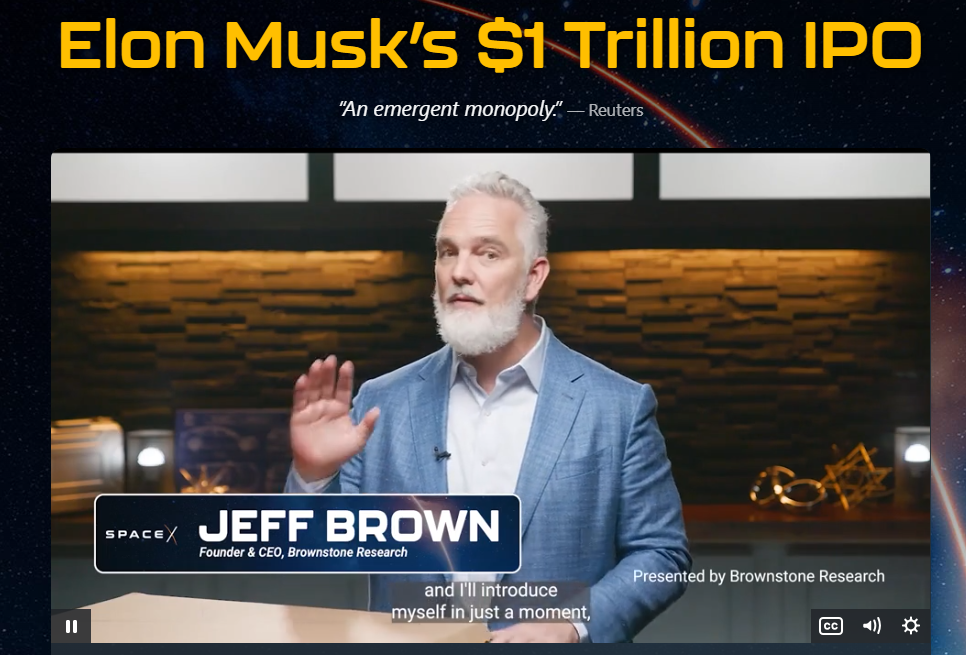
The hook is simple:
Elon Musk’s Starlink could be the biggest IPO of the decade, maybe a $1 trillion business, and Jeff Brown has found a way for you to “claim your stake” before it goes public, starting with around $500.
The sales letter (and video) builds that story around:
-
Starlink terminals – the small satellite dishes Elon’s company is shipping by the thousands.
-
Satellite network – thousands of satellites in low Earth orbit, with more launched every week.
-
Coverage & growth – millions of users, coverage in 100+ countries, strong growth in recurring revenue.
-
Government & defence use – military, White House, border security, aviation, etc.
-
Monopoly language – Starlink positioned as the first truly global internet carrier, with SpaceX controlling most satellite launches.
The emotional promise:
-
Get in before the IPO.
-
Let Elon’s “next trillion-dollar business” do the heavy lifting.
-
Potentially turn a relatively small stake into a life-changing win.
The crucial detail:
You don’t see how any of this works until you pay for the newsletter and read Jeff’s SpaceX/Starlink report.
You’re buying research and ideas, not a guaranteed pre-IPO allocation.
What I Think the Actual Investment Is (Without Spoiling Jeff’s Pick)
I’m sure 99% of people search for info on this pick just want to know the details.
You want to know what Jeff Brown is really hinting at — without paying.
Here’s the truth:
I can’t (and won’t) reveal his exact recommendation, but I can tell you what the clues point to.
Based on:
-
The “partner with Elon” framing
-
The $500 minimum
-
Heavy emphasis on explosive satellite growth
-
Reusable rockets + global internet expansion
-
Brownstone’s historical pattern of indirect “backdoor” plays
…it is almost certainly not a way to buy private SpaceX or Starlink equity.
Retail investors cannot buy those shares through a newsletter.
Instead, the pitch almost certainly points to:
A publicly traded company that supplies a critical component, technology, or infrastructure to SpaceX/Starlink.
That could include:
-
Satellite hardware
-
Aerospace components
-
Communication sensors
-
Rocket-related manufacturing
-
Ground-terminal technology
This is the most common structure for Brownstone Research pitches:
⭐ A real public company with a legitimate connection to a hype-driven story (in this case, Starlink).
What Stocks Might Jeff Brown Be Hinting At?
Before we dive into the full breakdown, here’s the part most people want to know:
“What stock is Jeff Brown actually teasing?”
To be crystal clear:
You only get the exact ticker inside his Near Future Report subscription but based on the clues in the presentation and what is publicly known about SpaceX suppliers, we can make an informed shortlist.
Here are plausible candidates that match the type of companies Brownstone typically teases:
1. Iridium Communications (IRDM)
A major player in satellite communications with existing government contracts.
They don’t supply Starlink directly, but the thematic overlap (low-orbit satellite infrastructure + global coverage) often lands them in similar teaser-style pitches.
Why it fits:
-
Satellite ecosystem exposure
-
Global communication theme
-
Government contracts (a big part of Jeff’s pitch)
2. Viasat (VSAT)
A competitor rather than a supplier — but Brownstone loves “David vs Goliath” narratives.
And Viasat is deeply involved in satellite networking, military broadband, and high-bandwidth transmission tech.
Why it fits:
-
Heavily involved in satellite internet infrastructure
-
Often teased in rival newsletters
-
Directly connected to the “global internet” story
3. Maxar Technologies (was MAXR)
Maxar was acquired and taken private, but historically it has been one of the most common “space tech” teaser stocks due to satellite manufacturing, imaging tech, and government work.
Why it fits the pattern:
-
Exactly the kind of company Brownstone typically selects
-
Deep ties to government space operations
(Note: now private, but often referenced in satellite-stock discussions.)
4. L3Harris Technologies (LHX)
They produce aerospace components, sensors, and advanced communications tech and have been part of SpaceX-related supply chains.
Why it fits:
-
Large DoD contractor
-
SpaceX-related components
-
“Government + space” angle is central to Jeff’s pitch
5. Trimble (TRMB)
Provides precision positioning technology used in aerospace, satellite mapping, and defence applications.
Why it fits:
-
Many analysts connect TRMB indirectly to satellite-navigation stories
-
Has been teased before in “Starlink supplier” pitches
6. Aehr Test Systems (AEHR) — more speculative
Brownstone loves small-cap “picks and shovels” plays.
Aehr is involved in semiconductor testing — not a known SpaceX supplier, but exactly the kind of moonshot that fits Jeff Brown’s style.
Why it fits:
-
Cheap enough for retail “$500 stake” narrative
-
High volatility = high marketing appeal
-
Could be tied into the “AI + satellites + explosive growth” storyline
So what’s the most likely category?
The clues strongly suggest the stock is:
A public company supplying technology that enables satellite communication, aerospace components, or high-frequency networking — NOT SpaceX itself.
The pitch leans so heavily on:
-
Government contracts
-
Satellite deployment
-
Low minimum investment ($500)
-
Massive future addressable market
…that this is almost certainly a “picks and shovels” supplier, not even a pure-play space company.
But again – to know Jeff’s exact choice, you must join his newsletter.
This shortlist simply helps readers understand the type of companies these teasers typically point to.
Who Is Jeff Brown (and Why Is He Fronting This)?
The promo spends a lot of time on his CV:
-
Former senior executive at:
-
Qualcomm
-
NXP Semiconductors
-
Juniper Networks
-
-
Angel investor in multiple private deals with big reported winners.
-
Tech analyst with a long-running newsletter track record.
-
Cites past calls on:
-
Bitcoin (when it was considered a scam)
-
Nvidia (for AI, before it was “the stock everyone talks about”)
-
Tesla (when it was widely hated)
-
The point of all this isn’t subtle:
“I’ve spotted big tech waves early before, so trust me when I tell you Starlink is the next one.”
That doesn’t mean he’s wrong – but it also doesn’t mean this particular opportunity will behave like Bitcoin or Nvidia. The marketing narrative always cherry-picks the very best examples.
What’s the Real Business Story? (SpaceX, Starlink, and the “Emergent Monopoly” Angle)
Underneath the hype, there is a strong real-world story:
-
SpaceX radically cut the cost of getting payloads into orbit with reusable rockets, solving a problem that used to make space access insanely expensive.
-
That opened the door to Starlink allowing them to launch thousands of sofa-sized satellites in low Earth orbit. Ground terminals (the dishes) beam internet to homes, ships, planes, and remote infrastructure and coverage in more countries every quarter.
The argument in the pitch goes roughly like this:
-
Reusable rockets → drastically cheaper launches.
-
Cheaper launches → huge satellite network becomes viable.
-
Huge satellite network → global internet carrier potential.
-
Global internet carrier + government contracts → massive valuation and potential future monopoly-like status.
-
If you own a stake before the IPO, and the market prices this as a trillion-dollar business, your upside could be substantial.
There’s a logic chain here – it’s just a very optimistic one, and it compresses a lot of assumptions into a clean story:
-
That Starlink will IPO as a standalone entity.
-
That the timing will be soon.
-
That private-market prices today are attractive, not already baking in sky-high expectations.
-
That competition, regulation, politics, or execution risk don’t derail the narrative.
Those are all “ifs” that the promo doesn’t dwell on.
What Are You Actually Buying?
When you pull the credit card out, you’re not buying Starlink.
You’re buying information and recommendations packaged like this:
1. A 1-Year Subscription to The Near Future Report
-
Monthly issues focusing on: AI, robotics, chips, self-driving, and other big tech trends.
-
Stock recommendations tied to those themes.
-
Market commentary and portfolio guidance.
2. Bonus Report: “The Biggest IPO of the Decade: How to Claim Your Stake in SpaceX”
This is the headliner.
It promises to:
-
Name the platform/vehicle/structure he believes gives you exposure to SpaceX / Starlink.
-
Show you the website and “exact steps”.
-
Explain how you could get started at around $500.
You don’t know in advance whether that’s:
-
A private-fund vehicle
-
A secondary marketplace with SpaceX exposure
-
A roll-up structure
-
Something more indirect
You only find out after you pay, which is the whole point of the teaser.
3. Bonus Report: “How to Profit from Elon Musk’s Robotics Revolution”
-
Focused on Tesla’s Optimus humanoid robot and the broader “physical AI” trend.
-
Highlights Tesla itself plus: A smaller supplier providing key sensors, which he thinks could ride the robotics wave.
4. Bonus Report: “How to Profit from the Next Nvidia”
-
Centres on a company he claims has developed AI chips more powerful than Nvidia’s current flagship.
-
Benchmarks are presented in a very flattering way in the promo – again, this is a high-upside, high-risk thematic bet, not a sure thing.
5. Member Area, Back Issues, Portfolio & Support
-
Access to back issues and all current open picks plus updates when he recommends buying, holding, or exiting.
-
Pricing in the promo: “List” price $499 and promo price $199 with a 60-day refund window.
So the product is a fairly standard high-ticket tech newsletter package.
The Starlink “$1 trillion IPO” angle is the wrapper used to get you through the door.
The Marketing Playbook (Why This Feels So Compelling)
It’s worth calling out the tactics, because they repeat across almost every big stock teaser in this space:
1. Big-Name Halo Effect
Heavy use of:
-
Elon Musk
-
SpaceX
-
Starlink
-
US government agencies, military, NASA, etc.
The idea is simple: if those names are involved, your brain fills in “this must be huge, and relatively safe.”
2. Outlier Examples Framed as “Models”
-
$1,000 into Amazon → nearly $1M
-
$1,000 into Nvidia → hundreds of thousands
-
Early Facebook, Uber, Microsoft, Bitcoin → multi-thousand-percent returns
Those examples are real but exceptional – they are not the average outcome of investing in hyped tech stories.
3. Implied Urgency Around the IPO
-
“IPO paperwork could be filed at any moment.”
-
“You’ll miss the biggest gains if you wait for the headlines.”
-
“Within the next 12 months” is repeated as if it’s a near-certainty.
In reality:
-
IPO timing is not guaranteed.
-
Market conditions, regulatory shifts, company strategy, and politics can all shift the timeline or structure.
-
Nobody outside Elon and his inner circle can promise when and how Starlink will list.
4. Simple, Low-Barrier Framing
The copy makes it sound like:
-
Anyone with $500 can get in.
-
The process is as easy as buying a stock.
-
All complexity is already handled.
In practice, pre-IPO and private-market exposure often involves:
-
Different minimums depending on where you live.
-
Platform risk / liquidity risk.
-
Valuations that may already be very aggressive.
That doesn’t mean Jeff’s method is automatically bad – but you shouldn’t assume it’s as plug-and-play as the promo suggests.
If you’ve seen Jeff Brown’s Freedom Factories teaser, you’ll recognise the same structure. Dramatic storytelling around a big tech opportunity, a mysterious device, and a “last chance” angle that ultimately leads into his paid research service.
A Quick Word on Stock Newsletters in General
Promos like this are part of a bigger ecosystem: publishers make money by selling subscriptions, not by guaranteeing your investment returns.
That doesn’t make them evil – but it does mean:
- The incentive is always to sell a compelling story.
-
Performance will be mixed:
-
Some picks will work well.
-
Others will disappoint.
-
A few may blow up entirely.
-
If you want a broader view of how this whole model works:
I’ve put together a dedicated guide on stock newsletters and teaser pitches – how they make money, the most common red flags, and how to use them (if at all) without getting sucked into unrealistic expectations. It’s worth reading alongside any promo that promises “the next trillion-dollar stock” or “secret pre-IPO access”.
Final Thoughts: Is Elon Musk’s “$1 Trillion IPO Stock” Pitch a Scam?
This isn’t one of the fake “AI income hacks” or get-rich-quick schemes I expose elsewhere on MarksInsights:
-
Brownstone Research is a legitimate financial publisher.
-
Jeff Brown is a real analyst with a long track record in tech.
-
SpaceX and Starlink are real companies doing world-changing work.
So the question isn’t whether the opportunity is fabricated — it’s how the marketing frames it, and whether it aligns with your goals and risk tolerance.
The pitch is dramatic because that’s how this industry markets research. The underlying opportunity could play out well — Starlink is a serious business with real scale and genuine potential. But the way into this opportunity (via a newsletter subscription and a speculative pre-IPO angle) still sits firmly in the high-risk, high-uncertainty category.
If you approach this as speculation, with money you can genuinely afford to lose, and without seeing it as a silver bullet for financial freedom, then it may have a place as a small, curiosity-driven bet.
Before you go…
If you simply want a legitimate way to make money, don’t care whether it’s stocks or something else, see my no.1 recommendation below – it shares a simpler way in my opinion.
👉 See my No.1 recommendation here

Mark is the founder of MarksInsights and has spent 15+ years testing online business programs and tools. He focuses on honest, experience-based reviews that help people avoid scams and find real, sustainable ways to make money online.