
Digital Cashback Exploit is one of the more theatrically constructed scam products I’ve come across. Most fake income systems at least try to sound like software. This one opens with the system itself narrating — speaking to you in first person as a self-aware rogue AI that escaped from a lab. It literally describes itself as “your personal financial ghost.”
That alone should tell you something. But the claims underneath the theatre are worth pulling apart properly, because the cashback angle is specific enough that some people will find it plausible.
First — This Is Important
Hey, my name is Mark. I’ve been reviewing online business programmes for over 15 years. Before diving in — the model I actually recommend for building real, recurring online income is below.
👉 My #1 Recommendation for Building a Real Online Income

Key Takeaways
- Digital Cashback Exploit claims to stack multiple cashback offers, referral bonuses, rebates, and browser extension rewards simultaneously — triggering all reward systems at once before they can stop it
- The sales video is narrated by the “software itself” — framed as a rogue AI that escaped from a lab, built by a 194 IQ Caltech dropout surviving on ramen and caffeine
- The “merchant rebate stacking” and “hidden mesh network” jargon is deliberately technical-sounding — it falls apart immediately under examination
- Modern retail payment systems have fraud detection that flags, reverses, and bans suspicious duplicate reward activity instantly
- No verifiable company, founder, or customer support behind the product
- Entry fee is $19 — the only money changing hands is yours going to them
- Your email data gets passed to affiliate marketers generating further scam offers in your inbox
- Verdict: Scam — the mechanism is fiction, the jargon is invented, and the income doesn’t exist
👉 My #1 Recommendation for Building a Real Online Income
What Is Digital Cashback Exploit?
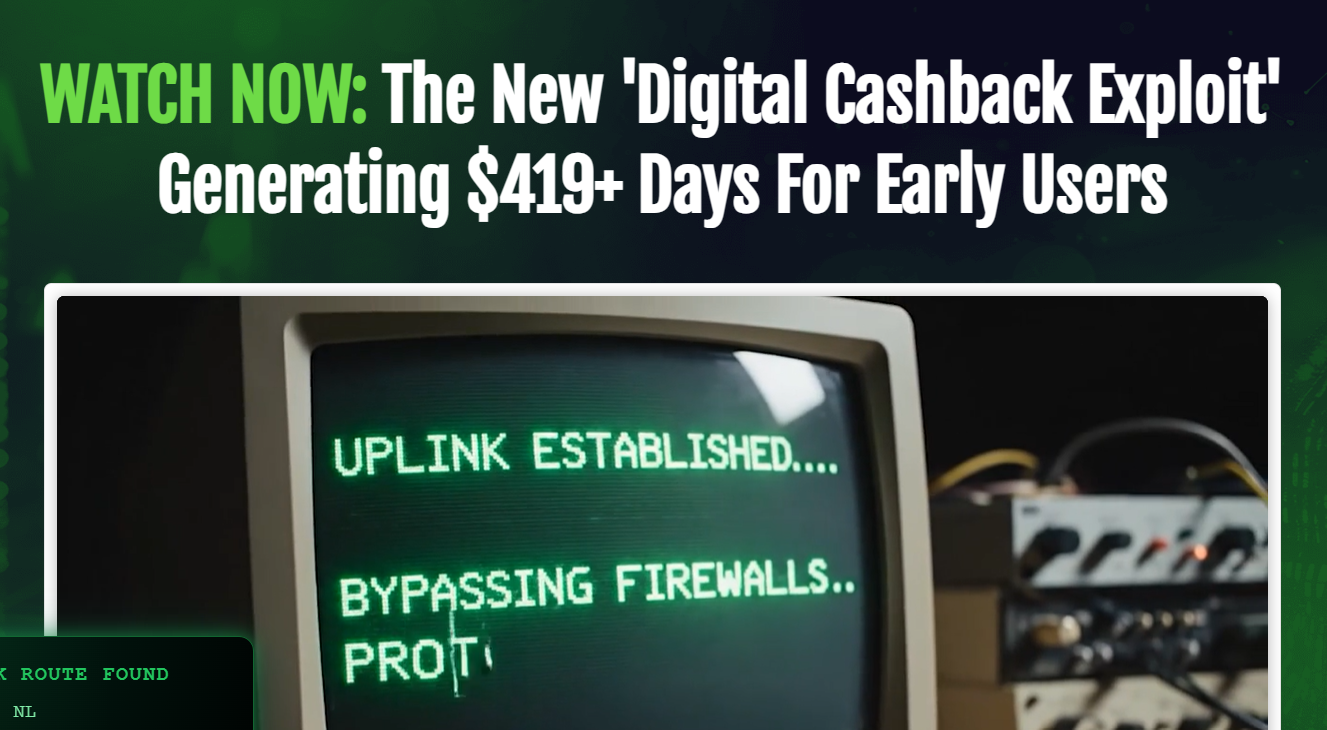
Digital Cashback Exploit is a $19 digital product that claims its software can combine multiple cashback offers, referral bonuses, rebates, browser extension rewards, and retailer incentives all at the same moment — firing all reward triggers simultaneously in the same microsecond, causing the system to accidentally pay out multiple rewards at once before it realises what happened.
The premise is that retailers have “guard rails” preventing normal users from stacking these rewards. The software bypasses those guard rails by triggering everything simultaneously, exploiting a gap in how cashback systems process transactions.
The sales pitch is wrapped in a story about a 194 IQ Caltech dropout who built a rogue AI system in a basement while surviving on ramen and caffeine. The software speaks in first person. It describes itself as a “personal financial ghost.” It references government raids, viral scandals, and security teams panicking to shut it down.
Why the Mechanism Is Fiction
This is worth being specific about, because the cashback stacking angle sounds almost technical enough to be plausible.
Modern retail payment and cashback systems are built by trillion-dollar corporations — Amazon, Walmart, major banks — with dedicated fraud prevention infrastructure running constantly. These systems don’t process rewards in a single microsecond window that can be exploited by firing multiple browser extensions simultaneously. Duplicate reward activity is flagged automatically. Suspicious transactions are reversed. Accounts that trigger unusual patterns get banned.
If a genuine loophole of this kind existed — one that caused retailers to pay out thousands of dollars per customer per day — it would be closed within hours of discovery, not turned into a $19 product sold to strangers on the internet. For context on what legitimate cashback platforms actually pay, see my Branded Surveys review — the gap between real cashback earnings and what Digital Cashback Exploit implies is enormous. The companies losing money would identify the pattern immediately. Their fraud teams would reverse the transactions, ban the accounts, and close the exploit before it became a “stable passive income system.”
The sales video never answers the obvious questions: where are the purchases coming from that generate these endless cashback payouts? Who is funding them? Why would retailers knowingly continue operating a system haemorrhaging millions of dollars every day? It can’t answer those questions because the mechanism doesn’t exist.
The Jargon Is Designed to Bypass Critical Thinking
“Merchant rebate stacking protocols.” “Hidden mesh networks.” “Reward trigger microsecond windows.”
None of these are real technical terms from the retail payments or cashback industry. They sound like technical terms — which is the point. Most people don’t have detailed knowledge of how retail payment systems work, so the terminology creates the impression of a sophisticated system without needing to describe one that actually functions.
When you slow down and examine what the claims actually mean — stacking cashback offers by clicking multiple browser extensions at the same time causes trillion-dollar companies to accidentally bleed money indefinitely — the story falls apart immediately. The jargon is the distraction. The questions you’re not meant to ask are the ones that expose it.
The Rogue AI Framing
The decision to have the software narrate the sales video in first person as a self-aware escaped AI is not a creative quirk. It’s a deliberate structural choice that serves the scam’s interests.
If a human narrator made these claims, you’d immediately ask: who are you? Where did you build this? What’s your real name? Can I find you online?
A “rogue AI” doesn’t have to answer any of those questions. There’s no founder to look up, no company to verify, no LinkedIn profile to check, no customer support email attached to a real person. The theatre of the AI narration is a shield against accountability.
The referenced headlines about government raids and security teams panicking have no credible source. Searching for this coverage independently returns nothing. Legitimate software companies don’t hide behind anonymous AI characters. They have founders, histories, documentation, and public reputations — because real businesses need trust to operate.
What Happens After You Pay
The $19 entry fee is the transaction. No passive cashback income follows. What you receive is either access to a basic dashboard, generic PDF content about cashback platforms, or redirects to legitimate cashback apps that pay normal micro-amounts — none of which resemble the income the product promises. This is the same pattern documented with Income Team X and Free Money Card V365 — a thin content wrapper behind a fictional income mechanism.
Your email address enters an affiliate marketing data chain. You will begin receiving a high volume of promotional emails for similar products — the inbox becomes a stream of further scams, which is a documented secondary revenue model for operations like this.
Red Flags
| Red Flag | Present in Digital Cashback Exploit |
|---|---|
| Software narrates its own sales pitch as a “rogue AI” | Yes — deliberately avoids human accountability |
| Invented technical jargon with no real industry basis | Yes — “merchant rebate stacking protocols,” “mesh networks” |
| Mechanism collapses under basic scrutiny | Yes — trillion-dollar fraud systems don’t work this way |
| Referenced media coverage doesn’t exist | Yes — government raids, viral scandals, no credible source |
| No verifiable founder, company, or support | Yes — anonymous operation |
| Data passed to affiliate marketing chain post-purchase | Yes — documented secondary revenue model |
| $19 entry fee is the only real transaction | Yes |
What to Do If You’ve Already Paid
Dispute the charge through your bank or card provider immediately. At $19 the amount is small but acting quickly prevents your data from being further circulated and establishes a record with your bank.
Mark any follow-up promotional emails as spam immediately and do not engage with them.
Report to the FTC at ReportFraud.ftc.gov if you’re in the US.
Final Verdict
Digital Cashback Exploit is a scam built around invented technical jargon, a fictional AI narrator designed to avoid human accountability, and a cashback stacking mechanism that has no basis in how real retail payment systems operate.
The $19 is the product. The rogue AI story, the Caltech dropout backstory, the government raids, the mesh networks — all of it is theatre constructed to make $19 feel like the key to something real.
It isn’t. The only money that changes hands is yours going to an anonymous operator.
👉 My #1 Recommendation for Building a Real Online Income
FAQ
What is Digital Cashback Exploit? A $19 digital product claiming its software stacks multiple cashback rewards simultaneously to generate passive daily income. The sales video is narrated by the “software itself” as a rogue AI.
Does the cashback stacking mechanism actually work? No. Modern retail payment systems have fraud detection that flags, reverses, and bans duplicate reward activity. The mechanism described has no basis in how real cashback platforms operate.
Who created Digital Cashback Exploit? No verifiable founder, company, or support contact is disclosed. The AI narration format is specifically designed to avoid this accountability.
What is the entry fee? $19. This is the only real financial transaction — no cashback income follows.
What happens to my data after I pay? Based on the documented pattern of similar products, your email enters an affiliate marketing chain resulting in a high volume of promotional emails for further scam products.
Can I get a refund? Dispute the charge through your bank or card provider directly. Do not rely on the product’s internal refund process given the absence of any verifiable customer support.

Mark is the founder of MarksInsights and has spent 15+ years testing online business programs and tools. He focuses on honest, experience-based reviews that help people avoid scams and find real, sustainable ways to make money online.