
When you land on the Automated Income Sites website, enter your name and immediately, something starts happening.
A progress bar kicks into life. Steps tick off one by one. Scanning winning product categories. Checking store availability in your region. Connecting supplier network. Analyzing top-converting products. A live feed shows payouts rolling in — $1,233.40 processed, a new store claimed in pet products, a member hitting $5,000 this month.
A counter tells you how much money you’re missing every second you’re not inside.
By the time the Automated Income Sites sales video ends, you feel like something real has already been built for you. All that’s left is to pay for hosting and activate it. But this entire thing is fabricated lies and is designed to trick you.
First… This Is Important
If you’re tired of scams like Automated Income Sites and just want a REAL way to make money online, see my no.1 recommendation below for making money online after 15+ years reviewing online income opportunities…
👉 My #1 Recommendation for Building a Real Online Income
Key Takeaways
- Automated Income Sites claims to build you a fully automated ecommerce/dropshipping store that generates $1,000+ per day on autopilot
- The “account preparation” progress bar runs for every visitor — it’s a scripted animation, not a real system building anything
- The live activity feed (payouts, store launches, member milestones) is fabricated social proof, not live data
- The product has existed in multiple versions under shifting creator names — “Marc Harrison,” “William Dale” — both unverifiable
- The $97 entry fee is for web hosting through a third-party service, not a done-for-you income system
- Multiple upsells follow the initial payment, none of which deliver the $1,000/day premise
- A cloned website is not a business — even if a store is technically set up, it won’t generate traffic, customers, or sales without significant additional work and marketing spend
- Ecommerce/dropshipping is a real business model that requires genuine effort; this product exploits its credibility to sell a fantasy version
👉 If you want to build real online income, here’s what I actually recommend instead
What Is Automated Income Sites?
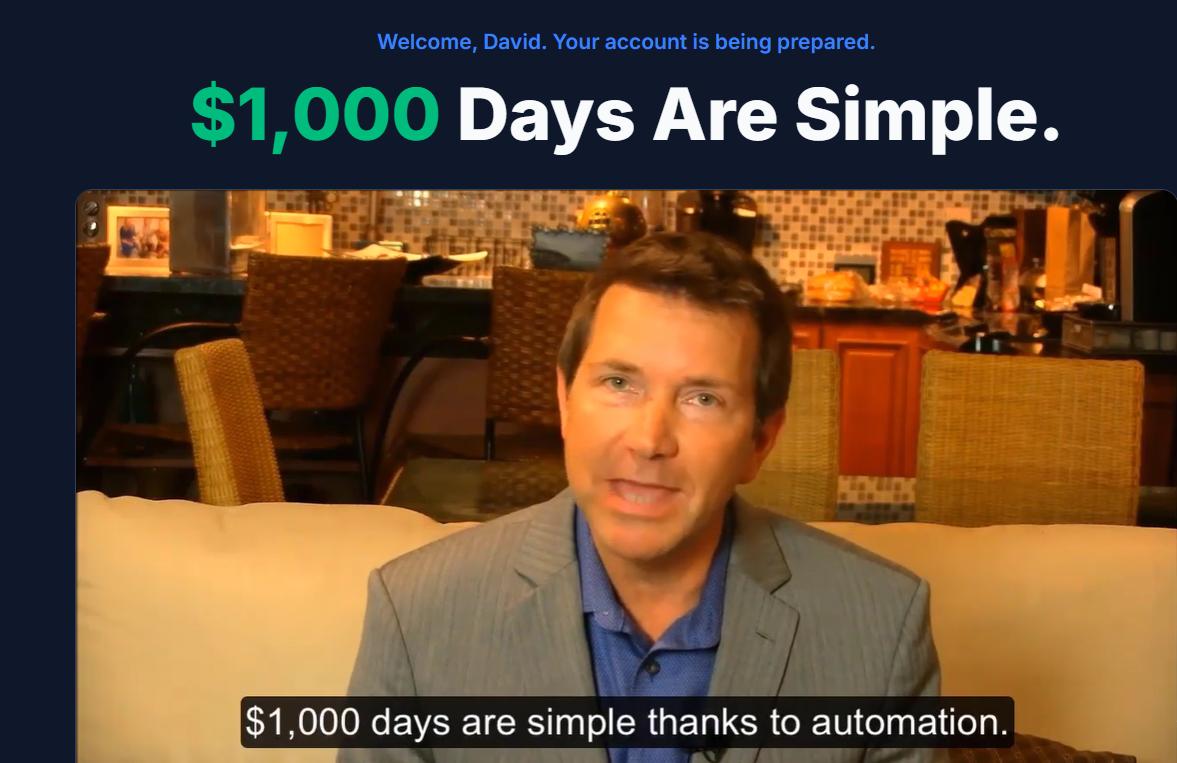
Automated Income Sites (automatedincomesites.com) presents itself as a done-for-you ecommerce system. The premise is that you don’t need to build a store, find products, or learn anything — the system does all of it automatically. Your store is pre-loaded with winning products, connected to suppliers, and ready to generate income. All you need to do is pay for hosting and switch it on.
The current version of the site is built around a slick onboarding sequence. Enter your name, and a progress animation begins — seven steps that simulate an automated system building your personalised account in real time. Once “complete,” a video walks you through the opportunity while a live activity feed shows other members receiving payouts and launching stores.
The core income claim: $1,000 per day. Some older versions of this product claimed it was achievable within 24–72 hours.
This product has been around in various forms for years, cycling through creator names and sales platforms. The fundamentals haven’t changed.
The Progress Animation — What It Actually Is
This is the most important thing to understand about how Automated Income Sites works on you psychologically, so it’s worth being direct about it.
The progress bar you see when you enter your name — Scanning winning product categories, checking store availability in your region, pre-building store template, connecting supplier network — is a scripted animation. It runs for every single visitor. It does not scan anything. It does not check anything. It does not build anything.
Every step that ticks off, every percentage point that advances, every status update that appears — it is all pre-written code that plays regardless of who is watching. The same sequence runs for the person in Texas who entered their name thirty seconds before you, and it will run for the next person thirty seconds after you leave.
The purpose of this animation is not informational. It is emotional. Watching a system appear to build something specifically for you creates a powerful sense of personalisation and momentum — a feeling that the work is already underway, that stopping now means walking away from something half-built. That feeling is the product’s most valuable asset. It’s engineered to make paying feel like completing something rather than starting something.
The Live Activity Feed — Is It Real?
Alongside the progress animation, the site displays a live feed of apparent activity: payouts being processed, new stores being claimed in specific niches, members hitting income milestones.
Payout of $1,233.40 processed. New store claimed — pet products. Member hit $5,000 milestone this month. Store launched in home goods niche.
This feed is not live data from real members. It is fabricated social proof — a ticker of invented activity designed to make the platform feel populated and successful. There are no member dashboards generating these notifications. No real-time payment processor is triggering these updates.
This technique — sometimes called “fake social proof” or a “live notification widget” — is a well-documented dark pattern in online marketing. It creates the impression of a thriving, active community of earners without requiring any actual earners to exist. Services that sell these widgets can be found easily online.
The counter showing “Members averaging $47.23/hr right now” and the ticking “You’ve missed $X.XX” figure are the same device — numbers chosen to feel specific and real, updating automatically to simulate a live system.
Who Is Behind Automated Income Sites?
This product has a complicated history of creator attribution. Older versions of the same product — operating under names like Auto Income Sites, My Commission Bootcamp, and Commission Code — attributed the system variously to “Marc Harrison” (described as having made $2.88 million online) and “William Dale.”
Neither name has a verifiable public profile. No professional history. No company registration. No media coverage consistent with the claims made. In at least one version, the URL slug for the refund guarantee page revealed the product’s favicon still identifying it as “Commission Bootcamp” — confirming the same product was being repackaged under a new name for a new audience.
The current version at automatedincomesites.com does not prominently name a creator — which is itself a step away from even the thin accountability of a pen-name persona.
The $1,000 Per Day Claim
Every version of this product has made the $1,000/day claim. Some versions have said you can hit it within 24–72 hours. The current version leads with “$1,000 Days Are Simple.”
Let’s look at what would actually need to happen for a brand new ecommerce store — even one pre-loaded with products — to generate $1,000 per day in profit.
Real dropshipping margins typically sit between 10–30% on product cost. To clear $1,000 profit per day at a 20% margin, you’d need to be processing roughly $5,000 in daily sales — around $150,000 per month in revenue.
Reaching that level of revenue requires:
- A well-optimised store with strong conversion rates
- Consistent paid advertising spend (typically hundreds to thousands of dollars per day at scale)
- Product research to identify genuine winners
- Supplier relationships that ensure reliable fulfilment
- Customer service infrastructure to handle returns and disputes
- Time — usually months, not days
Even established dropshippers with experience and ad budget don’t reliably hit $1,000/day profit consistently. The claim that a pre-built store handed to a beginner can achieve this within 24–72 hours has no grounding in how ecommerce actually works.
Shopify themselves note that only 10–20% of dropshipping businesses become profitable at all. That figure assumes real effort, real marketing spend, and real learning. It is not achievable through a $97 hosting payment.
The “Cloned Website” Problem
The core product — once you pay — appears to be access to a pre-built or templated ecommerce store, often accompanied by some form of web hosting arrangement.
This is where a fundamental misunderstanding gets exploited. Many people who are new to online business assume that having a website is the hard part. If someone gives you a working online store with products already loaded, the money should follow automatically.
In reality, a website is an empty building with no customers. Getting customers requires traffic, and traffic requires either:
- Paid advertising — Facebook Ads, Google Ads, TikTok Ads. Competitive products in popular niches routinely require $20–$100+ per day in ad spend before results can be tested, and that spend often doesn’t profit immediately.
- Organic content — SEO, social media, content marketing. This takes months to years to build.
A cloned store doesn’t solve either problem. Even if Automated Income Sites handed you an exact replica of the most successful Shopify store in the world, that replica would still generate zero sales without bringing traffic to it. This is not a technicality — it’s the most fundamental constraint of any online retail business.
Older reviews of this product consistently reported that after the initial purchase, buyers encountered upsells — additional products claiming to provide the traffic, the advertising, or the “done-for-you” marketing that the original purchase implied was included. The upsells didn’t deliver on the $1,000/day premise either.
The Urgency Mechanics
The site deploys several pressure devices:
The expiry countdown — “Your reservation expires in 21:46.” Your account slot has been reserved and will be released if you don’t act. This is the same manufactured scarcity we’ve documented across DP5 AI, Automatic Money App 4.0, and Lotto Cash Bot 2.0. There is no real reservation. The slot is available to anyone who visits the page.
The “you’ve missed” counter — A ticking figure shows how much money has theoretically flowed to other members since you arrived. This is not a real calculation. It’s a psychological nudge designed to make inaction feel costly.
The “members averaging $47.23/hr right now” — A specific figure implying a live, verified data stream. There is no such stream.
All three of these devices exist to shorten your decision window. The less time you spend thinking, the less likely you are to ask the questions that would lead you away from the payment page.
What Ecommerce Actually Requires
It’s worth being clear on this because the subject is legitimate — unlike the fictional financial mechanisms behind Automatic Money App 4.0 or Lotto Cash Bot 2.0, ecommerce and dropshipping are real business models that real people build real income from.
Dropshipping allows you to sell products without holding inventory — when a customer orders, your supplier ships directly to them. The model is legitimate and the market is genuinely large. But it operates like any other business:
- Product research matters. Most products don’t sell well. Finding winners takes testing.
- Marketing is the actual job. Building a store is maybe 10% of the work. Driving profitable traffic to it is the other 90%.
- Margins are thin. The 10–30% margin leaves little room for error on ad spend, returns, or supplier issues.
- It takes time. Building a profitable store to meaningful income levels typically takes months of iteration.
None of this is hidden. None of it requires a $97 system promising to shortcut the process. The affiliate marketing for beginners and how to start affiliate marketing guides on this site cover what building real online income actually looks like — without the animation theatre.
Pros and Cons
| Pros | Cons |
|---|---|
| Ecommerce is a real and legitimate business model | The progress animation is scripted — it builds nothing |
| A basic store setup might technically be provided | The live activity feed is fabricated social proof |
| Low entry price relative to the claims made | $1,000/day claim has no basis in how ecommerce works |
| No traffic source is provided — a store without traffic earns nothing | |
| Creator identity is unverifiable across multiple product versions | |
| Upsells follow the initial purchase without delivering the core promise | |
| Urgency mechanics (countdown, “you’ve missed” counter) are manufactured | |
| Product has been relaunched repeatedly under different names — a pattern of rebranding after complaints |
Frequently Asked Questions
Is Automated Income Sites a scam?
The product uses fabricated progress animations, invented live activity data, and earnings claims that have no basis in real ecommerce economics to sell a hosting package. The $1,000/day premise is not achievable through what the product actually provides.
Does the progress animation mean my account is being built?
No. The “Scanning winning product categories / Connecting supplier network” sequence is a scripted animation that runs identically for every visitor. It does not perform any real account setup.
Is the live activity feed showing real member payouts?
No. The payout notifications and milestone updates are fabricated social proof. They are not pulled from real member accounts or payment processors.
Who created Automated Income Sites?
The product has operated under the creator names “Marc Harrison” and “William Dale” in previous versions, neither of which is verifiable. The current version does not prominently name a creator.
What do you actually get for your money?
Access to a web hosting service and, in some versions, a pre-templated ecommerce store. Neither constitutes a working income system — without traffic and marketing, a store generates no sales.
Can dropshipping make $1,000 per day?
Experienced dropshippers operating at scale can reach significant revenue. But it requires product research, substantial advertising spend, conversion optimisation, and months of iteration — not a pre-built template and a $97 fee.
Why does the product keep relaunching under new names?
A consistent pattern across products like this — relaunching as “Auto Income Sites,” “My Commission Bootcamp,” “Commission Code” — suggests the previous version accumulated enough negative reviews or payment processor complaints to require a rebrand. The core product remains the same.
Final Verdict
Automated Income Sites is built around a single, powerful piece of theatre: the progress animation. It makes you feel like something real is being built for you before you’ve paid a penny. By the time it completes, the emotional work is already done — you feel like you’re activating something, not buying something.
The live activity feed reinforces that feeling with fabricated social proof. The countdown timer and “you’ve missed” counter compress your decision window. The $1,000/day claim gives you an outcome to attach to the feeling.
None of it corresponds to how ecommerce actually works. Dropshipping is a real business model — but it requires traffic, marketing spend, product testing, and time. A pre-built store with no visitors earns nothing. That’s not a hidden caveat. It’s the most basic constraint of online retail, and it’s the thing this product most carefully avoids mentioning.
This product has been repackaged and relaunched multiple times across different creator names and platforms. That pattern of rebranding follows a trail of complaints and negative reviews. The animation gets slicker with each version. The underlying offer doesn’t change.
If you want to build something real online, the path exists — but it starts with understanding what the work actually involves, not with a progress bar that runs the same way for everyone.
👉 Here’s what I personally recommend instead — a legitimate way to build real online income

Mark is the founder of MarksInsights and has spent 15+ years testing online business programs and tools. He focuses on honest, experience-based reviews that help people avoid scams and find real, sustainable ways to make money online.