
1 Tap Cashflow video starts with a bold claim.
It tells you that a deposit of $415.34 is currently pending in your name. Then, in bold orange text: “Closing or leaving this page will INSTANTLY REVERSE this payment back to the sender.”
A green button below it reads: “RESUME VIDEO & CLAIM $415.34.”
There is no deposit. There is no sender. No money is going anywhere. That popup is a JavaScript scare tactic — fabricated on the spot to stop you leaving the page before you’ve bought something.
That’s how 1 Tap Cashflow introduces itself. And it tells you almost everything you need to know about what follows.
First — This Is Important
Before you spend a dollar on any online income system, see what I actually recommend after 15+ years in this space. I’ve tested more of these platforms than I care to count — and my #1 recommendation is nothing like 1 Tap Cashflow.
👉 My #1 Recommendation for Building a Real Online Income
Key Takeaways
- 1 Tap Cashflow opens with a fake “pending deposit” popup warning you that $415.34 will be “instantly reversed” if you leave — this is a fabricated scare tactic, not a real payment
- The product is a $47 front-end funnel with almost certain upsells behind it
- The “one-tap” income concept is pure marketing — there is no mechanism by which tapping anything generates income
- The underlying business model is not disclosed before purchase
- No named founder or verifiable track record exists for this product
- The fake pending deposit popup alone is sufficient reason to avoid this product entirely
- Verdict: Scam. The fake payment popup is deliberate deception. Do not buy it.
👉 My #1 Recommendation for Building a Real Online Income
The Fake “Pending Deposit” Popup: A Scam Tactic in Plain Sight
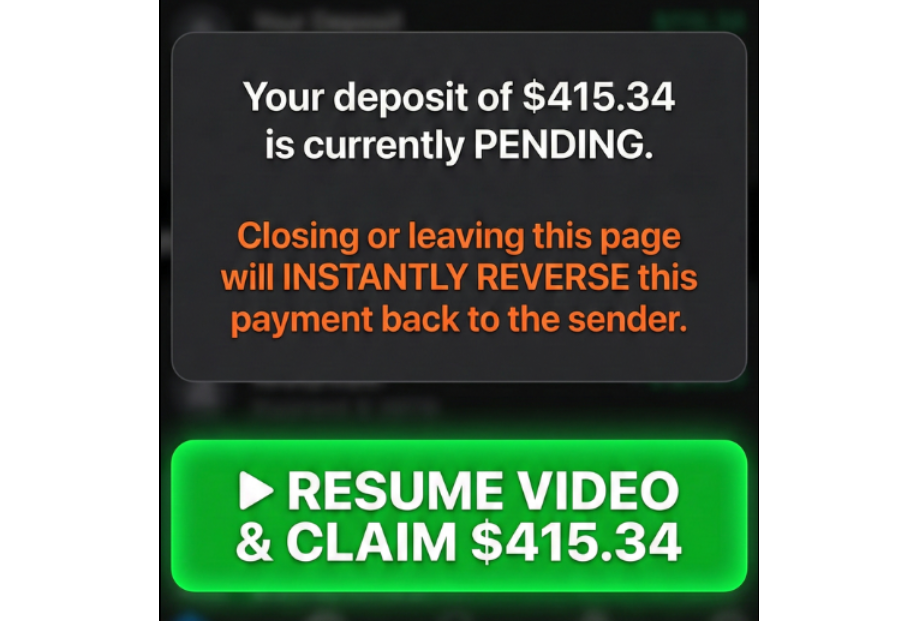
Let’s start here, because this is the most important thing to understand about 1 Tap Cashflow.
Before you even reach the main sales content, a popup appears telling you that a deposit of $415.34 is currently pending. The orange text warns that closing or leaving the page will “INSTANTLY REVERSE” this payment back to the sender. A large green button urges you to resume the video and claim your $415.34.
This is not real.
There is no deposit. No payment has been initiated on your behalf. No sender exists. The specific dollar amount — $415.34 — was not calculated from anything related to you. It’s a number chosen to feel specific and believable, in exactly the same way that Goldbot AI’s “$2,920 next payout” and Cada-3’s personalised certificate ID are chosen to feel specific and believable.
What it actually is: a JavaScript popup triggered the moment any visitor attempts to leave the page. The sole purpose is to create panic — to make you feel that you are about to lose real money by clicking away. It’s designed to override your skepticism with urgency, to stop you doing the one thing that would protect you: leaving the page and doing some research.
The FTC has clear rules about deceptive practices at the point of sale. Telling a consumer that money is pending in their name when no such money exists is not a marketing grey area. It is a lie designed to extract a purchase. Full stop.
Any product that opens with this tactic has already shown you its character. Everything that follows — the training, the automation tools, the $47 price point, the money-back guarantee — exists in the context of a sales process that began with a fabricated emergency.
That alone should end the conversation for most people. But let’s go through the rest of it anyway.
What Is 1 Tap Cashflow?
One Tap Cashflow is a digital product — almost certainly sold through a platform like JVZoo or WarriorPlus — that markets itself as a beginner-friendly online income system. For a one-time fee of $47, you get access to a training programme, automation tools, and a dashboard that supposedly guides you through building an online income stream.
The system is positioned around the idea that most online business platforms are unnecessarily complicated. The creators claim to have stripped away the technical complexity, leaving a clean, simple pathway that beginners can follow without needing coding skills, marketing experience, or a big budget.
The “tap” concept — the thing that makes this product’s name distinctive — refers to the idea that activating the system’s components requires minimal effort. Simple actions, not complicated buildouts. Taps, not marathons.
That’s the pitch. It’s an appealing one. It’s also deliberately vague about some of the most important questions a buyer should be asking.
What Does 1 Tap Cashflow Actually Teach?
This is where things get murky — and it’s the most important section of this review.
The promotional material for 1 Tap Cashflow describes the platform in terms of what it feels like to use: simple, automated, beginner-friendly, structured. It talks about dashboards, modules, and pre-built components. What it doesn’t clearly explain is the underlying business model. How does money actually get made?
From what’s available, Tap Cashflow appears to be built around some form of affiliate marketing — promoting products or services for a commission. The “automated marketing tools” and “ready-to-use marketing pages” described in the sales material are consistent with the kind of pre-built affiliate funnels you find in most entry-level digital products in this space.
If that’s correct, here’s what that means in practice.
You get a pre-built funnel — a landing page and email sequence — already set up. Your job is to send traffic to it. People click your link, opt in, and eventually buy something. You earn a commission when they do.
The automation handles the funnel mechanics. It does not handle traffic. And traffic is the entire game.
This is the gap that products like 1 Tap Cashflow consistently underplay. Getting people to your pages — through paid ads, SEO, social media, or other channels — is the skill that actually determines whether you earn anything. It’s also the skill that takes the most time and money to develop. The training might touch on traffic generation, but no $47 product solves this problem for you.
I’ve covered this same pattern across dozens of similar systems. If you want to understand the real landscape of online income methods that actually work, the business models are real — the shortcuts to them aren’t.
The “Beginner Friendly” Promise: What It Actually Means
1 Tap Cashflow leans heavily on the idea of simplicity. No technical skills required. No complicated setup. Just follow the steps.
This framing is common across the entry-level digital product market, and it’s worth unpacking what it actually delivers versus what it implies.
What “beginner friendly” genuinely means in the context of a product like this: the interface is clean, the training is structured in a logical order, and you won’t need to write code or build a website from scratch. These things are real. For someone who has never touched an online business tool before, a well-designed dashboard and a step-by-step module structure does reduce the initial intimidation factor.
What “beginner friendly” does not mean: that earning money will be easy, quick, or guaranteed. Online income — through any legitimate model — requires consistent effort over weeks and months before meaningful results typically appear. Tap Cashflow’s own small-print acknowledges this: “results vary depending on effort and strategy” and “success requires patience, consistency, and willingness to learn.”
These disclaimers are buried at the end of the sales material. The front-end experience is much more optimistic.
The gap between the implied ease of the sales pitch and the actual reality of building online income is where most buyers of products like this end up disappointed — not because the training is necessarily bad, but because expectations were set incorrectly from the start.
Who Is Behind 1 Tap Cashflow?
This is a question the promotional material doesn’t answer.
There is no named founder attached to Tap Cashflow in the available information. No face, no backstory, no track record you can verify independently. The system is presented as a platform built by “the creators” — a framing that keeps the people behind it conveniently anonymous.
This matters for a specific reason. When you’re evaluating whether a business education product is worth your money, the track record of the person teaching it is one of the most important signals available. Has this person actually built sustainable income using the methods they’re selling? Can you verify their results independently? Are there students whose success you can trace back to this specific training?
With no identified founder, none of these questions can be answered. You’re buying training from someone whose credentials you cannot assess.
Compare this to legitimate course creators in the online income space — people like Ryan Hildreth or Jordan Welch, who have public-facing businesses, documented results, and reputations on the line. You might not agree with everything they teach, but you can evaluate them as people before handing over money. With Tap Cashflow, you can’t.
The $47 Price Point and What’s Behind It
$47 is a front-end price designed to look like a low-risk entry point. And in isolation, it is. $47 for a training programme isn’t inherently unreasonable.
The question is what comes after it.
Products in this category — $37 to $67 front-end, JVZoo or WarriorPlus distribution, beginner-friendly positioning — almost universally include a funnel of upsells behind the initial purchase. These typically include:
- An “upgraded” or “done-for-you” version of the system ($97–$197)
- A traffic or leads package ($97–$297)
- Coaching or mentorship access ($297–$997)
- A “reseller” licence letting you sell the product yourself
The total cost of getting the “complete” version of a system like this often runs to several hundred dollars. None of that is necessarily disclosed at the point of the $47 purchase.
This isn’t unique to Tap Cashflow — it’s structural to how these products are built and sold. But if you’re budgeting $47 for an online income system, it’s worth knowing that the number on the sales page is rarely the full picture.
What the Sales Copy Doesn’t Tell You
The 1 Tap Cashflow promotional material is enthusiastic and optimistic. It’s also notable for what it leaves out.
The specific business model — what you’ll actually be doing to make money — is not clearly stated before purchase.
Traffic generation — the critical skill that determines whether any of this works — is mentioned briefly as “beginner-friendly strategies” without any specifics.
Realistic income expectations — despite multiple references to “online income opportunities” and “digital income streams,” there are no income disclosures, no average earnings figures, and no case studies with verifiable results.
The upsell structure — not mentioned at all in the promotional material reviewed.
The identity of the people behind it — completely absent.
None of this makes Tap Cashflow definitively a scam in the way that Goldbot AI or Cada-3 are scams — products built on fabricated premises with no legitimate underlying model. Tap Cashflow appears to be built around a real business model (affiliate marketing), with real training, and genuine automation tools.
The problem is the gap between what the marketing implies and what the product realistically delivers. That gap is wide, and it’s where most buyers end up disappointed.
1 Tap Cashflow: Pros and Cons
| Pros | Cons |
|---|---|
| Low entry cost at $47 | Opens with a fabricated “pending deposit” popup — deliberate deception |
| Money-back guarantee mentioned | Anonymous creator — no verifiable track record |
| Accessible from any device | Business model not disclosed before purchase |
| Traffic generation — the hard part — not solved by the system | |
| Almost certain upsell funnel behind the $47 entry | |
| Vague income claims with no disclosures or case studies |
Is 1 Tap Cashflow a Scam?
Yes.
The fake pending deposit popup settles this. When a product opens by fabricating a financial emergency to prevent you from leaving the page, it has crossed from aggressive marketing into deliberate deception. That’s not a grey area. That’s a scam tactic, used by a product that knows it cannot survive scrutiny.
Whatever training or tools exist inside Tap Cashflow — and they may well exist in some form — they are being sold through a process that begins with a lie. The anonymous creator, the undisclosed business model, the certain upsell funnel, the vague income claims: all of these would be red flags on their own. Together, and combined with a fabricated payment popup at the entry point, they form a clear picture.
This product is not a legitimate training platform that happens to use pushy marketing. It is a funnel built to extract money from people who are looking for a way out of financial stress, using manufactured urgency and fake social proof to close the sale before the buyer has time to think.
Do not buy it.
What to Do Instead
If the appeal of Tap Cashflow is the idea of building automated online income without a massive technical learning curve, the underlying model is genuinely worth pursuing. Affiliate marketing for beginners is one of the most accessible entry points into online income that actually scales.
The difference between a $47 anonymous funnel product and a real approach to this model comes down to what you’re actually learning and who’s teaching it. The best systems I’ve found don’t promise you can tap a button. They teach you a real skill — building websites or pages that attract search traffic and earn commissions passively over time — with enough transparency that you can assess whether it’s right for you before you spend anything.
That’s what my number one recommendation is built on. It’s not instant. But it’s real, it’s verifiable, and it compounds.
Final Verdict
1 Tap Cashflow is a scam.
Not because the concept of affiliate marketing is illegitimate — it isn’t. Not because automation tools don’t exist — they might. But because the product announces itself with a fabricated payment popup designed to panic you into purchasing before you can think clearly. That’s not a marketing tactic. That’s a deliberate lie told at the moment you’re most vulnerable to it.
Add the anonymous creator, the undisclosed business model, the inevitable upsell funnel, and the complete absence of verifiable results — and there is no version of this that ends well for the buyer.
Save your $47. If you want to understand how online income actually works and find a system built by someone with a real track record, start below.
👉 My #1 Recommendation for Building a Real Online Income

Mark is the founder of MarksInsights and has spent 15+ years testing online business programs and tools. He focuses on honest, experience-based reviews that help people avoid scams and find real, sustainable ways to make money online.