
Looking for a Whop review and wondering whether it’s worth it?
Whop is an all-in-one platform where you can sell digital products, courses, Discord communities, software, templates—basically anything digital—without monthly fees. Just build your offering, list it on their marketplace, and start earning. The platform claims creators earn an average of $8,413 per month, and they’ve processed over $1 billion in transactions.
With Iman Gadzhi’s credibility behind it since he became co-owner in April 2025 and backing from heavyweight investors like Peter Thiel and The Chainsmokers, Whop positions itself as the future of the creator economy. They’re projecting massive growth and presenting this as the opportunity to get in early on the next big platform.
I spent weeks researching Whop, reading through hundreds of creator reviews, analyzing the fee structure, understanding the Iman Gadzhi connection, and evaluating whether this is truly a viable business opportunity for ordinary people. Here’s what I found.
First – This Is Important…
Before we dive into the detailed Whop review, let me be upfront: if your goal is building sustainable, predictable income online—not specifically selling digital products on a marketplace—there are far better options than becoming dependent on a platform you don’t control.
👉 Click here to see the business model I recommend

After testing dozens of online business models over 15+ years, I’ve found the most reliable approach is local lead generation: building websites that rank on Google for local service searches, then renting the leads to local businesses for $500-$2,000 per month.
Why is this better than selling on Whop?
- You own the assets completely – No platform can suspend your account or change the rules
- Predictable recurring revenue – Monthly payments from business clients, not hoping products sell
- No marketplace fees – Keep 100% of your earnings minus basic hosting costs ($10/month)
- Less competition – Local niches aren’t saturated like digital product marketplaces
- No account suspension risk – Your business can’t disappear overnight due to platform decisions
I’ll explain more about this alternative later, but if you’re looking for the most reliable way to build online income in 2026, platform dependency is a risk you should carefully consider.
👉 Click here to see the business model I recommend
Key Takeaways
- What it is: Whop is a digital marketplace where creators sell courses, communities, software, memberships, and digital products—all hosted on Whop’s platform
- Who runs it: Founded in 2021 by Steven Schwartz, Cameron Zoub, and Jack Sharkey; Iman Gadzhi became co-owner and strategic partner in April 2025
- The cost: Free to start, but Whop takes 3% on all sales + payment processing fees (2.7% + $0.30 domestic cards) + 30% commission on marketplace-referred sales
- The promise: Build a digital product business without monthly fees, get marketplace exposure, and earn recurring income
- The reality: Platform works for some, but common complaints include frozen accounts, sudden suspensions, marketplace saturated with low-quality products, confusing interface, and fees that add up quickly
- Account suspension risk: Multiple creators report accounts frozen after first sale or at revenue milestones ($1K, $5K, etc.) with 90-day holds on funds
- Iman Gadzhi connection: He’s now co-owner and uses Whop for his own products, but his involvement is primarily strategic/financial—not a guarantee of creator success
- My verdict: Legitimate platform with real success stories, but significant platform risk, marketplace quality issues, and better alternatives exist for those seeking predictable income
👉 RECOMMENDED: Click here to check out my No.1 recommendation
What Is Whop?
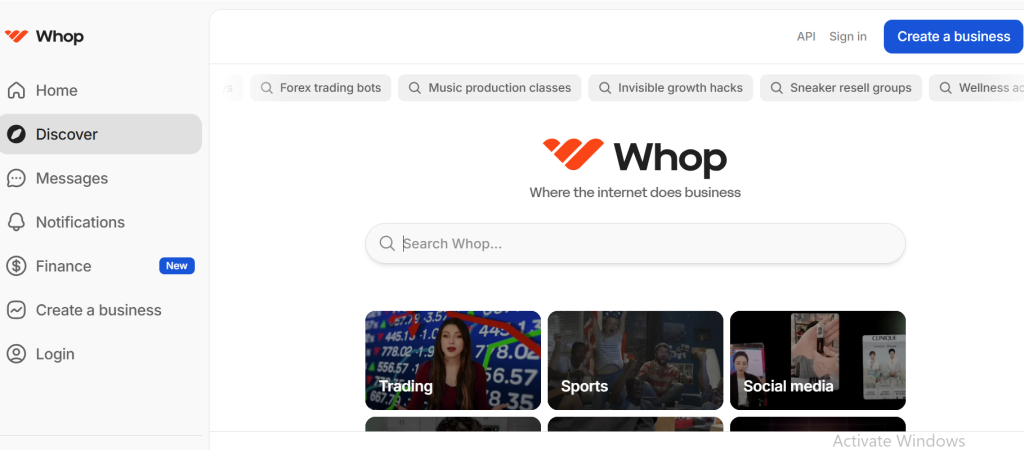
Whop is a digital marketplace and commerce platform founded in 2021 by three friends: Steven Schwartz, Cameron Zoub, and Jack Sharkey. The platform was created to make it easy for creators and entrepreneurs to sell digital products and services online without dealing with multiple tools and platforms.
Think of it as a hybrid between Shopify (for digital goods), Discord (for communities), and Gumroad (for selling). Everything is hosted on Whop—you don’t need separate hosting, payment processors, email tools, or community platforms.
What You Can Sell on Whop
The platform is designed for selling virtually any digital product or service:
- Online courses – Video lessons, downloadable materials, quizzes
- Discord communities – Paid access to private servers with automatic role assignment
- Software and SaaS – License keys, API access, tools
- Digital downloads – eBooks, templates, Notion boards, spreadsheets, graphics
- Consulting and coaching – One-on-one sessions or group coaching
- Memberships – Recurring subscriptions to exclusive content
- Telegram or Slack communities – Similar to Discord integration
The appeal is that you can bundle multiple offerings together. For example, sell access to a Discord community + a course + weekly coaching calls + downloadable templates—all in one purchase.
The Iman Gadzhi Connection
In April 2025, Iman Gadzhi joined Whop as a co-owner and strategic partner. This was huge news in the online business space because Iman is one of the most influential figures in digital education, with millions of followers across YouTube, Instagram, and TikTok.
Iman’s involvement brings:
- Credibility – His reputation gives Whop legitimacy in the creator space
- Distribution – His massive audience provides instant visibility
- Strategic guidance – His experience scaling digital product businesses helps Whop refine their platform
- His own products – Iman moved his flagship offering “Monetise” (reportedly generating $10M+ in revenue) to Whop
Whop is now valued at $800 million after their July 2024 Series B funding round, and they’re processing over $1 billion in transactions annually. With Iman on board and backing from Peter Thiel, The Chainsmokers, and Insight Partners, the platform is positioned for significant growth.
But—and this is important—Iman’s involvement doesn’t guarantee that average creators will succeed on the platform. His success comes from having millions of followers and a proven personal brand. Most creators don’t have that advantage.
How Whop Works as a Business Opportunity
Let’s break down the actual mechanics of making money on Whop.
Step 1: Create Your “Whop”
You sign up for free and create what Whop calls your “Whop”—essentially your digital storefront. This involves:
- Choosing what you want to sell (course, community, software, etc.)
- Setting up your offering using Whop’s app ecosystem
- Configuring pricing (one-time, subscription, or tiered plans)
- Creating your sales page and checkout flow
The interface uses a modular system with 59 different “micro-apps” you can add. This is one of the major complaints—even experienced tech founders find the platform confusing and unintuitive.
Step 2: Add Content and Configure Access
Depending on what you’re selling:
- Upload course videos or written content
- Connect your Discord, Telegram, or Slack server
- Set up software license keys or API access
- Create member-only resources
Whop handles the integration automatically. When someone buys, they instantly get access to whatever you’ve configured.
Step 3: Drive Traffic
Here you have two options:
Option A: Bring Your Own Traffic (3% fee)
- Market on your own social media, email list, YouTube, etc.
- Send buyers to your Whop page
- You pay 3% platform fee + payment processing
Option B: Use Whop’s Marketplace (30% fee)
- List your product on Whop’s “Discover” marketplace
- Get exposure to 4+ million monthly visitors
- Whop promotes top sellers
- You pay 30% commission on marketplace sales + payment processing
Most successful creators use both—their own traffic for lower fees, and the marketplace for additional discovery.
Step 4: Manage Customers and Fulfill Orders
Whop handles:
- Payment processing (Stripe integration)
- Tax compliance (VAT, sales tax)
- Automatic access granting
- Customer support ticketing
- Analytics and dashboard
You focus on delivering value and marketing.
The Realistic Path to Earnings
Whop claims creators earn an average of $8,413 per month. But let’s break down what that actually means:
Beginner (Months 1-3):
- Building your offering
- Testing pricing and messaging
- Driving initial traffic
- Typical earnings: $0-$500/month
Growing (Months 4-9):
- Refining product based on feedback
- Scaling traffic through content or paid ads
- Building initial customer base
- Typical earnings: $500-$2,000/month
Established (Year 1+):
- Consistent traffic and conversions
- Affiliate network promoting your product
- Recurring subscription revenue building
- Typical earnings: $2,000-$10,000+/month
The $8,413 average includes highly successful creators making $50K-$100K+/month, which skews the mean upward. The median is likely much lower.
The Fee Structure: What You Actually Pay
This is where things get complicated—and expensive.
Base Platform Fees
Own Traffic Sales (3%):
- 3% platform fee on each transaction
- Example: $100 sale = $3 to Whop
Marketplace Sales (30%):
- 30% commission on marketplace-referred sales
- Example: $100 sale = $30 to Whop
Payment Processing Fees (On Top of Platform Fees)
Domestic cards:
- 2.7% + $0.30 per transaction
- Example: $100 sale = $2.70 + $0.30 = $3.00
International cards:
- Additional 1.5% fee
- Example: $100 international sale = additional $1.50
Currency conversion:
- Additional 1% if currency conversion needed
- Example: $100 EUR to USD = additional $1.00
Real Cost Examples
$100 sale via own traffic:
- Platform fee: $3.00 (3%)
- Processing: $3.00 (2.7% + $0.30)
- Your net: $94.00
- Effective rate: 6%
$100 sale via marketplace:
- Platform fee: $30.00 (30%)
- Processing: $3.00 (2.7% + $0.30)
- Your net: $67.00
- Effective rate: 33%
$5,000/month in sales via own traffic:
- Platform fees: $150
- Processing fees: ~$150
- Total fees: $300/month
At scale, that $300/month is more expensive than most dedicated course platforms like Kajabi ($89-$199/month) or Teachable ($59-$249/month) with no transaction fees.
The Major Problems with Whop
Let me walk you through the significant issues creators report.
Problem #1: Account Freezes and Suspensions
This is by far the most common and serious complaint. Multiple creators across Trustpilot, Reddit, and BBB report:
Sudden account suspensions after first sale
- Account gets frozen after first successful transaction
- Whop claims “suspicious activity” or “fraudulent payment patterns”
- Funds held for 90 days while under review
Freezes at revenue milestones
- Common triggers: $1K, $5K, $10K in sales
- Automatic holds placed on withdrawals
- No clear explanation provided initially
100% payout holds
- Not partial reserves—entire balance frozen
- Creates zero cash flow for the creator
- No way to access funds during review period
One BBB complaint details a creator whose mother had just passed away, their account was suspended at payout time, and Whop held a 90-day freeze on their entire balance despite proof of legitimate fulfillment.
Another Trustpilot review: “These people are outrageous with fees. Then after I received the payment they put a reserve on my account so I could not withdraw my money.”
Whop’s Response: They claim these reviews are for fraud prevention and compliance. But the execution—freezing entire balances without warning at critical growth milestones—destroys creator businesses.
Problem #2: Marketplace Quality Issues
The Whop marketplace is saturated with low-quality and scam products. Multiple reviews mention:
“The marketplace has quality issues. When I first saw Whop’s marketplace, I was overwhelmed by numerous spammy groups and market-ish vibes. Many offerings feel like get-rich-quick schemes rather than genuine educational content.”
This creates two problems:
For buyers: Hard to distinguish quality offerings from scams For legitimate creators: Your product is surrounded by junk, affecting perceived credibility
Whop’s rapid growth prioritized quantity over quality curation, and it shows.
Problem #3: Confusing, Constantly Changing Interface
Even tech CEOs struggle with Whop’s interface. Luke Alexander (70K Twitter followers, SaaS founder) tweeted:
“Am I the only person trying to make a new course on Whop and I can’t figure out how to do anything?”
The platform uses 59 different “micro-apps” you can add to your offering. The problem:
- Unclear what each app does
- UI changes frequently
- No clear navigation logic
- Even Whop support struggled to explain it
One Medium article by a CEO with 15 years of experience said: “Even tech CEOs are getting lost… Confusion = friction. Friction = drop in sales. Drop in sales = dead business.”
Problem #4: Limited Customer Support
When issues arise—especially around frozen accounts or disputes—support is slow and often unhelpful.
Common complaints:
- “Support says ‘nothing we can do’ about random $25 chargebacks”
- “Been trying to resolve account suspension for weeks, no clear answers”
- “Email responses are generic, don’t address specific issues”
For a platform processing $1B+ annually, the support infrastructure appears inadequate.
Problem #5: The Fees Add Up Fast
That “no monthly fee” marketing sounds great until you realize:
- 3% platform fee on every sale
- 2.7% + $0.30 payment processing
- 30% on marketplace sales
- Chargeback fees
- Dispute handling fees
- Withdrawal fees
Once you’re generating $5K+/month, you’re paying more in fees than you would with dedicated platforms that charge monthly subscriptions but no transaction fees.
One creator calculated: “At $5K/month, the 3% fee alone is $150—more expensive than Kajabi’s Kickstarter plan. If you scale past $5,000 a month, you are definitely paying too much.”
Problem #6: Platform Dependency Risk
This is the fundamental issue: you’re building your entire business on a platform you don’t control.
Whop can:
- Suspend your account at any time
- Change fee structures
- Alter marketplace algorithms
- Modify terms of service
- Freeze your funds for 90 days
Multiple Reddit posts detail creators who built successful offerings on Whop, only to have their accounts suspended without clear explanation, losing their entire income source overnight.
👉 See why local lead generation eliminates platform risk
What Real Creators Say
I spent considerable time reading verified reviews across platforms. Here’s what patterns emerged:
Positive Reviews (Common Themes)
“The platform makes it easy to bundle multiple offerings together—course + community + tools—in one purchase.”
“Marketplace exposure helped me get initial sales I wouldn’t have gotten otherwise.”
“When things work, the dashboard and analytics are solid.”
“Support resolved my issue after I escalated through proper channels.”
Notice what these positive reviews say: the platform works when things go smoothly. The tools are functional. The concept is good.
Negative Reviews (Common Themes)
“Account suspended after first sale, funds frozen for 90 days with no explanation.”
“The marketplace is full of scams and low-quality products that make legitimate offerings look bad.”
“Random chargebacks and Whop sides with customers immediately, freezing funds.”
“Fees are way higher than advertised once you factor in everything.”
“Interface is confusing and changes constantly.”
“Support is slow and unhelpful when you have serious issues.”
The Pattern
Creators who praise Whop typically:
- Have smaller operations ($1K-$3K/month)
- Haven’t experienced account freezes
- Value the bundling and integration features
Creators who criticize Whop typically:
- Hit revenue milestones that triggered freezes
- Experienced account suspensions
- Lost significant income due to platform issues
- Found fees unsustainable at scale
Comparing Whop to Alternatives
How does Whop stack up against other options?
Whop vs. Kajabi
Kajabi:
- Monthly fee: $89-$199
- Transaction fees: 0%
- Advanced course features, email marketing, funnels
- Professional course delivery
- Established platform (13+ years)
Better if: You’re serious about courses and want robust tools
Whop better if: You want free entry and can handle limitations
Whop vs. Gumroad
Gumroad:
- Free to start
- 10% transaction fee (flat)
- Simple, straightforward
- Less sophisticated than Whop
- No community integration
Better if: You’re selling simple digital downloads
Whop better if: You need community features and bundling
Whop vs. Skool
Skool:
- Monthly fee: $99
- 0% transaction fees
- Built-in gamification
- Strong community features
- Less marketplace saturation
Better if: Community engagement is your priority
Whop better if: You want marketplace exposure
Whop vs. Building Your Own System
DIY (Stripe + Hosting + Tools):
- Setup complexity: High
- Monthly costs: $50-$150
- Transaction fees: 2.9% + $0.30 only
- Complete control and ownership
Better if: You have technical skills and existing traffic
Whop better if: You want speed and simplicity
The reality: if you’re generating consistent revenue ($5K+/month), dedicated platforms or your own system become more cost-effective than Whop’s fee structure.
Why Local Lead Generation Is a Better Alternative
If your goal is building sustainable online income—not specifically selling digital products on marketplaces—let me show you why local lead generation is superior.
You Own the Assets Completely
With Whop:
- Platform can suspend your account anytime
- Algorithm changes affect your marketplace visibility
- Terms of service can change
- Your entire business depends on Whop’s continued operation
With Local Lead Generation:
- You own the websites completely
- No platform controls your income
- No algorithm to please
- Your assets can’t be suspended or frozen
Predictable Recurring Revenue
With Whop:
- Income depends on constant sales
- Need to keep creating new content
- Marketing never stops
- Revenue fluctuates month to month
With Local Lead Generation:
- Businesses pay monthly for leads ($500-$2,000/site)
- Once ranking, income is predictable
- Minimal ongoing maintenance required
- Revenue is stable and recurring
No Marketplace Fees
With Whop:
- 3% platform fee on all sales
- 2.7% + $0.30 payment processing
- 30% marketplace commission
- At $5K/month = $300+ in fees
With Local Lead Generation:
- $10/month hosting per site
- That’s it. No other fees.
- At $5K/month (5 sites at $1K each) = $50 in fees
- You keep 99% of earnings
Less Competition
With Whop:
- Marketplace saturated with similar products
- Everyone teaching the same methods
- Constant new creators entering
- Race to bottom on pricing
With Local Lead Generation:
- Local niches have low competition
- Most local businesses have terrible SEO
- Not many people know about this model
- Sustainable competitive advantage
No Account Suspension Risk
With Whop:
- Multiple creators report frozen accounts
- 90-day holds on funds
- Sudden suspensions at revenue milestones
- No recourse when platform makes decisions
With Local Lead Generation:
- Your sites can’t be “suspended”
- No one can freeze your payments
- Businesses pay you directly
- You control everything
Real Example Comparison
Whop Digital Product Creator (Typical Experience):
- Spends 2-3 months building course/community
- Lists on marketplace
- Generates $2,000/month in sales after 6 months
- Pays $120/month in fees (6%)
- Account frozen at $5K revenue milestone
- Loses income for 90 days during review
- Net: Inconsistent, platform-dependent income
Local Lead Generation (My Experience):
- Built HVAC site in Phoenix for $75
- Spent 3 months ranking through basic SEO
- Called local HVAC companies, rented leads for $1,500/month
- Site still ranks 2.5 years later
- Pay $10/month hosting
- Zero platform risk
- Replicated process in other cities/niches
- Net: $8,500/month from 7 sites, minimal ongoing work
The difference is ownership, predictability, and not being dependent on a platform that can freeze your account without warning.
👉 Go here to learn local lead generation
Common Questions About Whop
Is Whop legitimate or a scam?
Whop is a legitimate platform that processes real transactions and pays out creators. However, the common complaints about frozen accounts, marketplace quality issues, and hidden fees are also real. It’s not a scam, but it has significant operational issues.
How much can you actually make on Whop?
Whop claims creators earn an average of $8,413/month, but this is heavily skewed by top performers. Most beginners earn $0-$500/month initially. Success depends entirely on your traffic, product quality, and avoiding account freezes.
Why do people’s accounts get frozen on Whop?
Whop claims account freezes are for fraud prevention and compliance checks. Common triggers include: first sale, first withdrawal attempt, and revenue milestones like $1K, $5K, or $10K. The issue is that Whop often freezes 100% of funds for 90 days, destroying creator cash flow.
Is the 3% fee really that cheap?
At first glance yes, but once you add payment processing (2.7% + $0.30), marketplace fees (30%), and factor in scaling, the total cost often exceeds dedicated course platforms. Above $5K/month in revenue, you’re typically paying more than platforms with monthly subscriptions but no transaction fees.
Should I trust the marketplace?
Multiple reviews warn that the marketplace is saturated with low-quality and scam products. This affects legitimate creators’ credibility by association. Quality curation has not been a priority as Whop scaled rapidly.
What happens if Whop suspends my account?
Based on creator reports, you lose access to your funds (held for 90 days), lose your income source immediately, and may struggle to get clear explanations or fast resolutions from support. This is the primary risk of platform dependency.
Is Iman Gadzhi’s involvement a good sign?
Iman’s involvement brings credibility and growth potential to the platform. However, his success comes from massive existing audiences and personal brand—advantages most creators don’t have. His ownership stake doesn’t guarantee that average creators will succeed.
My Honest Verdict: Should You Build on Whop?
Let me give you my straight assessment.
Whop is a legitimate platform that works for some creators. The tools exist, transactions process, and people do make money. The bundling capabilities and marketplace exposure are genuine advantages for the right person.
However:
The platform has serious operational issues that create significant risk for creators:
- Account freezes are common and devastating – Multiple verified reports of frozen accounts at critical revenue milestones, with 90-day holds destroying creator cash flow
- Marketplace quality is poor – Saturation with scams and low-quality products affects all creators’ credibility
- Fees add up quickly – Despite “no monthly fee” marketing, total fees at scale often exceed dedicated platforms
- Interface is confusing – Even experienced tech founders struggle with the 59-app modular system
- You’re building on rented land – Platform dependency means Whop controls your income, can change terms, and suspend you without recourse
Who might still consider Whop:
- Creators with existing audiences who can drive their own traffic
- Those testing digital product ideas without upfront investment
- People comfortable with platform risk and potential account issues
- Anyone willing to accept 6-33% fees depending on traffic source
Who should avoid Whop:
- Anyone seeking predictable, stable income
- Those who can’t afford sudden 90-day income interruptions
- Creators wanting to own their business completely
- People already generating $5K+/month (fees become unsustainable)
- Anyone seeking long-term business security
The fundamental issue: You’re building your entire business on someone else’s platform. No matter how good the tools are, platform dependency is a risk that has destroyed countless online businesses.
Iman Gadzhi’s involvement doesn’t change that fundamental risk—it just makes the platform more attractive on the surface.
A Better Path Forward
If you’re serious about building online income in 2026, consider this: the most successful online entrepreneurs own their distribution and assets. They don’t build entirely on platforms that can freeze their accounts or change terms overnight.
Local lead generation provides:
- Complete ownership of your income-generating assets
- No platform risk – you can’t be suspended or frozen
- Lower total fees ($10/month hosting vs. 6-33% of every sale)
- Predictable recurring revenue from business clients
- Less competition in local niches vs. saturated digital product marketplaces
It’s not as flashy as “selling on Iman Gadzhi’s platform.” But it’s more reliable, more predictable, and builds real wealth over time.
The best online business isn’t the one with the most hype or the celebrity endorsement. It’s the one that actually works for ordinary people without requiring massive audiences, luck with algorithms, or hoping a platform doesn’t freeze your account.
👉 Click here to discover my No.1 recommendation

Mark is the founder of MarksInsights and has spent 15+ years testing online business programs and tools. He focuses on honest, experience-based reviews that help people avoid scams and find real, sustainable ways to make money online.