
Hey, it’s Mark from MarksInsights.
If you’ve stumbled across The Brain Song while searching for ways to improve your focus or memory, you’ve probably seen some pretty bold claims. Better concentration, sharper memory, increased productivity, mental clarity—all supposedly from listening to a simple audio track for 12 minutes a day.
Sounds convenient, right? Maybe even too convenient.
So I wanted to dig into this and figure out what The Brain Song actually does, whether the science behind it holds up, and most importantly whether it’s worth your time and money. Or is it just another scam?
Before We Get Started
I’ve been reviewing digital products and “life optimization” tools for years now, and I’ve noticed a pattern: most of them promise transformational results but deliver incremental improvements at best. Some are genuinely helpful. Most aren’t.
If you’re specifically looking for something that can build real, long-term income rather than just tweaking your mental performance, I’d recommend checking out what I consider the most reliable model for building an online business. You can see that here:
👉 Go here to see the best business to start online!
But if you’re genuinely curious about whether The Brain Song can help with focus and mental clarity, let’s break it down.
What Is The Brain Song, Exactly?
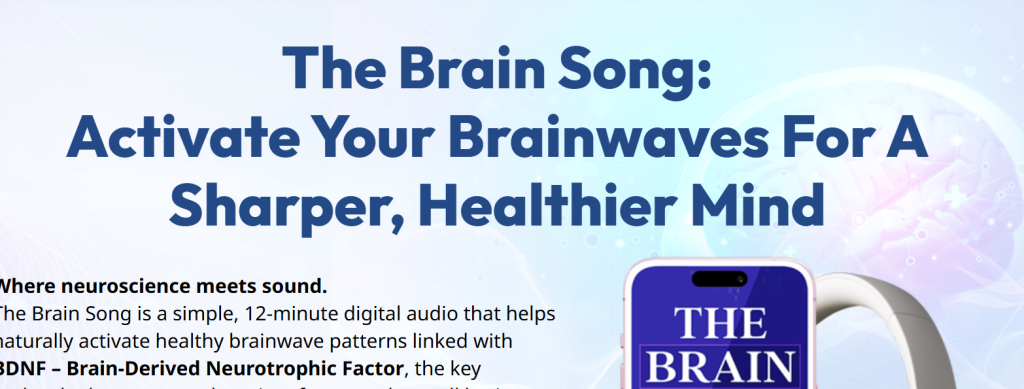
The Brain Song is a digital audio program created by Dr. James Rivers, a neuroscientist who’s worked with institutions like MIT’s Brain Aging Initiative. The program is essentially a single audio track—somewhere between 12 and 17 minutes depending on which version you’re looking at—that uses something called brainwave entrainment.
The idea is that by listening to specific sound frequencies through headphones, you can encourage your brain to synchronize with those frequencies, nudging it into states associated with better focus, creativity, and calm alertness.
The program specifically targets gamma waves (around 40 Hz), which research has linked to memory formation, learning, and cognitive processing. You’re supposed to listen once a day with headphones, and that’s basically the entire system.
No complex exercises. No supplements. Just audio.
The Science Behind It: What’s Actually Real?
Let’s talk about what we actually know from research, because this is where things get interesting.
Brainwave Entrainment Is Real (But Subtle)
Brainwave entrainment itself is a legitimate concept that’s been studied for decades. The basic principle is that rhythmic external stimuli—like sound, light, or even vibration—can influence your brain’s natural electrical activity and encourage it to sync up with those rhythms.
This isn’t pseudoscience. Researchers at MIT, Harvard, and other institutions have been investigating gamma wave stimulation, particularly at 40 Hz, for its potential effects on memory and cognitive health. Some studies in mice have shown promising results, including reductions in amyloid plaques associated with Alzheimer’s disease. Human trials have been more limited but have shown some improvements in memory recall and cognitive performance, especially in people with mild cognitive impairment.
Here’s what’s important to understand, though: the effects observed in research studies tend to show improvements from an average of 75% to 85% in cognitive scores, which is measurable but not dramatic. And most of these studies involve consistent, repeated exposure over weeks, not instant results.
What Entrainment Actually Does
When you listen to audio designed for brainwave entrainment, especially with binaural beats (where slightly different frequencies are played in each ear), your brain can gradually begin to match that external rhythm. This can help you transition into specific mental states—like the focused alertness associated with gamma waves or the relaxed clarity linked to alpha waves.
But here’s the crucial distinction: entrainment nudges your brain toward certain states. It doesn’t rewire your intelligence or unlock hidden cognitive reserves. The effects are typically things like:
- Easier transition into focused work
- A sense of mental calm or clarity
- Slightly better attention during tasks
- Reduced mental noise and distraction
These are helpful, but they’re not the same as dramatically increasing your IQ or transforming your memory overnight.
The BDNF Claims Need Context
One of the marketing angles for The Brain Song involves Brain-Derived Neurotrophic Factor (BDNF), which is often called “Miracle-Gro for the brain.” BDNF is a real protein that plays an important role in neuroplasticity—your brain’s ability to form new connections and adapt.
The issue is that BDNF levels are primarily influenced by things like exercise, sleep quality, stress management, and nutrition. There isn’t strong clinical evidence that listening to an audio track directly increases BDNF production in any meaningful way.
At best, the indirect effects—reduced stress, better mental state, improved consistency with a daily routine—might create conditions that support healthier brain function overall. But claiming that a 12-minute audio file “activates” BDNF is a stretch that goes beyond what current research actually shows.
What You Actually Get When You Buy It
The purchase is straightforward. For a one-time payment (typically around $39), you get:
- The 12-17 minute audio track (downloadable)
- Basic instructions on how to use it
- Some general tips on brain optimization
- Lifetime access to the file
- A 90-day money-back guarantee
There’s no subscription, no upsells to navigate, and no complicated system to follow. That’s actually a point in its favor—it’s simple and transparent about what it is.
👉 Go here to see the best business to start online!
Setting Realistic Expectations
Let’s talk about what The Brain Song claims versus what you’re realistically likely to experience.
The marketing materials suggest improvements in:
- Focus and concentration
- Memory and recall
- Mental clarity
- Stress reduction
- Creativity
- Overall productivity
And honestly? Some of those benefits are plausible, especially if you’re someone who struggles with mental clutter or has trouble settling into deep work.
But here’s the thing: a significant portion of any benefit you experience might come from the ritual itself, not necessarily from any proprietary frequency magic. Consider what’s actually happening when you use The Brain Song:
- You’re carving out 12 minutes of intentional downtime each day
- You’re creating a consistent habit
- You’re putting on headphones and deliberately stepping away from distractions
- You’re signaling to your brain that it’s time to focus
All of that matters. In fact, research on habit formation and attention management suggests that consistent daily rituals can have meaningful effects on cognitive performance, completely independent of any audio frequency technology.
That doesn’t mean The Brain Song is useless—it just means the value might come as much from the structure and consistency as from the specific frequencies used.
Who Might Actually Benefit?
Based on what we know about brainwave entrainment and user feedback patterns, The Brain Song seems most likely to help:
- Students who need a pre-study focus ritual and want something more guided than traditional meditation
- Professionals looking for a simple daily mental reset that doesn’t require learning complex techniques
- Creative workers who want help getting into a flow state without spending 45 minutes meditating
- People experiencing stress-related brain fog who need a structured way to dial down mental noise
It’s especially useful if you’re the type of person who struggles with meditation but recognizes you need some kind of daily mental practice. The passive nature of it—you just listen, you don’t have to “do” anything—makes it more accessible than traditional mindfulness practices for some people.
Who Should Probably Skip It
On the other hand, The Brain Song probably isn’t a good fit if:
- You’re expecting instant, dramatic changes to your intelligence or memory
- You’re dealing with clinical cognitive issues that require professional treatment
- You’re not willing to use headphones consistently (the binaural beat technology really does require them)
- You want measurable, guaranteed neurological changes backed by your own brain scans
- You already have a meditation or focus practice that works well for you
This is a subtle tool. If you’re looking for something with objectively measurable clinical effects, you’re probably better off focusing on the fundamentals: quality sleep, regular exercise, good nutrition, and stress management.
👉 Go here to see the best business to start online!
What Real Users Actually Say
Looking at verified user feedback across multiple sources, responses tend to cluster into a few patterns:
Positive experiences typically mention:
- Feeling “clearer” or “more present” after a few weeks
- Finding it easier to drop into focused work
- Less mental chatter and anxiety, especially in the morning
- A sense of mental energy without jitteriness
Neutral or mixed responses usually note:
- Effects are subtle rather than dramatic
- It takes consistent use over several weeks to notice anything
- Benefits seem to plateau after initial improvements
- Hard to separate the effect of the audio from the effect of having a daily ritual
Negative experiences often involve:
- Expectations that were too high based on marketing
- Not using it consistently enough to see any benefit
- Already having low stress and good focus, so not much room for improvement
- Sound quality issues with cheap headphones
The pattern here is pretty clear: people who approach it as a supportive tool and stick with it for a few weeks tend to report subtle but noticeable benefits. People who expect a cognitive transformation in a few days tend to be disappointed.
The Pricing and Risk Factor
At $39 for lifetime access with a 90-day money-back guarantee, the financial risk is relatively low. That’s actually more generous than a lot of similar products, which often have 30-day or 60-day refund windows.
The real investment isn’t money—it’s consistency. If you buy it and use it twice before forgetting about it, you won’t get any benefit regardless of whether the technology works. But if you’re willing to commit to 12 minutes a day for at least a month, $39 isn’t an unreasonable price to test whether it helps you.
Breaking Down the Pros and Cons
What Works in Its Favor:
- Simple, no-fuss daily routine
- Based on legitimate (if modest) scientific principles
- Affordable one-time payment
- No subscription or recurring charges
- 90-day money-back guarantee reduces risk
- Doesn’t require you to learn any new skills or techniques
Where It Falls Short:
- The BDNF claims are overstated and lack direct evidence
- Effects are likely to be subtle, not transformative
- Won’t compensate for poor sleep, high stress, or other lifestyle factors
- Not a replacement for clinical treatment of cognitive issues
- Marketing creates unrealistic expectations
- Requires consistent, daily use to see any benefit
👉 Go here to see the best business to start online!
My Honest Take: Is It Worth Trying?
Here’s the bottom line: The Brain Song is not a scam, but it’s also not a cognitive breakthrough.
What it actually is: a structured audio tool that might help you reduce mental noise, transition into focused work more easily, and create a beneficial daily ritual. For some people, especially those who struggle with traditional meditation but recognize they need some kind of daily mental practice, it could be a useful addition to their routine.
The key word there is “addition.” This isn’t something that replaces the fundamentals of cognitive health—adequate sleep, regular physical activity, good nutrition, social connection, and stress management. Those are still the foundation. The Brain Song, at best, is a tool you can layer on top of that foundation.
If you approach it with realistic expectations—as a potential support for focus and mental clarity rather than a magic bullet—and you’re willing to commit to using it daily for at least a month, it might be worth the $39 to see if it works for you. The 90-day guarantee means you can get your money back if you’re not seeing any benefit.
But if you’re looking for dramatic cognitive enhancement, verifiable increases in memory or intelligence, or a solution to serious focus issues, you’re probably better off working with a therapist or cognitive specialist who can address the root causes.
Final Thoughts
The Brain Song sits in an interesting space between legitimate neuroscience research and consumer wellness product. The underlying science of brainwave entrainment is real, and gamma wave stimulation has shown promise in research settings. But there’s a big gap between what happens in controlled studies and what you can expect from a consumer audio product.
It’s a mental hygiene tool—like flossing for your focus, if you will. It’s not going to revolutionize your cognitive function, but it might help you maintain better mental clarity if you use it consistently as part of a broader approach to brain health.
For what it’s worth, if I had to choose between spending $39 on The Brain Song or $39 on a month’s worth of premium coffee to fuel late-night productivity sessions, I’d probably pick The Brain Song. At least it won’t mess with your sleep.
Just go in with eyes open about what it actually is, and you won’t be disappointed.
If you want to see the business model I personally recommend for building long-term income, check it out here: 👉 Go here to see the best business to start online!

Mark is the founder of MarksInsights and has spent 15+ years testing online business programs and tools. He focuses on honest, experience-based reviews that help people avoid scams and find real, sustainable ways to make money online.