
Hey, it’s Mark from MarksInsights.
If you’ve seen Dylan Sigley’s ads for Dropservicing.com / Drop Servicing Blueprint, you’ve probably heard some version of:
“Start a 6-figure AI drop servicing business in 30 days…
Quit your job… Work 5 hours a week from your laptop.”
It sounds suspiciously close to the usual “new AI method” pitch but dropservicing is a real business model, and Dylan has been in this game for years, not five minutes.
So the real question isn’t “is this a total scam?”
It’s… Is Drop Servicing Blueprint actually worth the money? And is this the right model for you?
Quick Note Before We Dive In
I’ve been reviewing make-money-online programs for 15+ years. Some are solid, some are overhyped, and some are flat-out dangerous for beginners.
If you’re simply looking for a reliable online business that doesn’t rely on big promises, complicated client projects, or chasing the latest AI trend… there’s one model I consistently recommend above anything else:
👉 See my No.1 recommendation here
Key Takeaways (If You’re in a Hurry)
- Dropservicing is a real model (selling services to clients, outsourcing fulfilment) and Dylan does run real businesses using it.
- Drop Servicing Blueprint is a premium, in-depth course (around $1,497 at the time of writing) that walks you through building a dropservicing agency step-by-step, with templates, spreadsheets, outreach systems, and support.
- There’s strong social proof: hundreds of detailed Trustpilot reviews with an overwhelmingly positive rating, plus lots of student success stories (though results obviously vary).
- The marketing is hypey – timelines, “AI makes it easy” messaging, and “start in 30 days” claims are optimistic. It’s real work: sales, systems, client management.
- It’s not for most people: you’ll need time, discipline, and comfort with outreach and sales to get value from it. This is closer to building a proper agency than a quick side hustle.
-
Verdict: Legit course + legit model, but demanding. Great fit if you know you want to build a service business and are ready to grind. Not ideal if you’re looking for something simple, low-stress, or part-time.
👉 Want something simpler? Here’s the business model I prefer
What Is Dropservicing.com / Drop Servicing Blueprint?
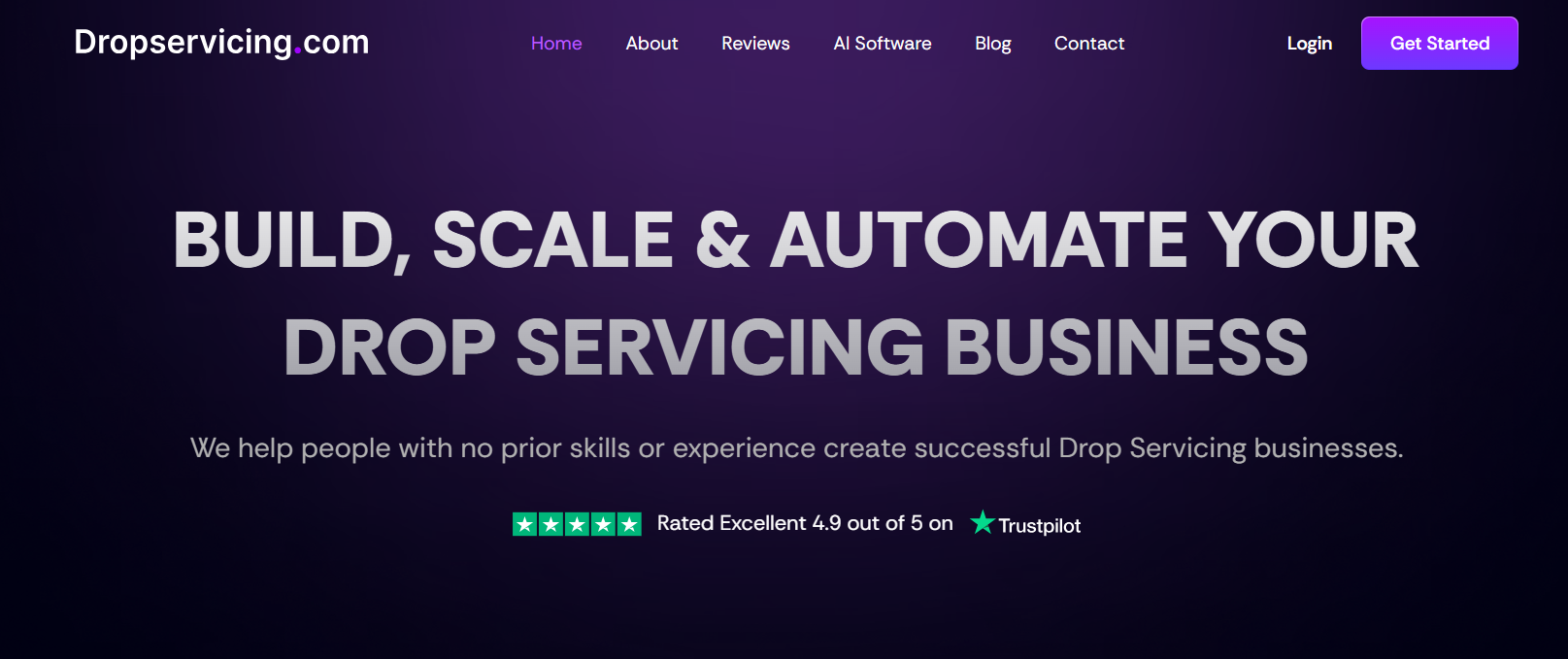
Dropservicing is basically running an agency without doing the actual fulfilment work yourself.
You sell a service (copywriting, web design, ads, video, etc.) to clients. You outsource the work to freelancers or a fulfilment team at a lower cost and you keep the margin/manage the relationship, quality and systems.
Dylan’s brand (Dropservicing.com / Drop Servicing Blueprint) takes that core idea and wraps it in:
- A full “start-to-finish” curriculum
- A 7-day (more realistically: few weeks) accelerator
- Templates, SOPs, spreadsheets
- Community and live Q&A calls
His newer marketing leans heavily into “AI Drop Servicing” – i.e., using AI to speed up research, copy, systems and delivery. But under the hood, it’s still:
A service business with clients, not a magic AI cash machine.
If you’re still at the stage of comparing models, I’d seriously suggest stepping back and reading a broader How to Make Money Online guide that compares dropservicing, local lead gen, ecommerce, affiliate marketing, etc. Once you’ve seen where dropservicing really sits in that landscape, offers like this are much easier to judge.
How the Business Model Actually Works
Strip away the “7-figure laptop lifestyle” angle and dropservicing looks like this:
-
Pick a service + niche
-
e.g. Facebook ads for gyms, Google Ads for home services, copywriting for coaches, funnel builds for course creators.
-
-
Generate leads and book calls
-
Cold email, cold DM, LinkedIn outreach, content, sometimes paid ads.
-
-
Close clients on a retainer or project fee
-
You might charge $1,500–$5,000+ per project or $1k–$3k/month retainers.
-
-
Outsource fulfilment
-
You hire freelancers or a white-label team to actually do the work.
-
You keep a margin (often 40–70% after costs once things are dialled in).
-
-
Manage projects + quality
-
You are the “brains” and the point of contact: strategy, expectations, reporting, client relationships.
-
If that sounds like a real business rather than a “hack”, that’s because it is.
Dropservicing is essentially:
“Building an agency with systems + contractors instead of doing everything yourself.”
That’s important to understand before you spend four figures on a course – because no course can remove the reality that:
- You’ll need to talk to humans
- You’ll hear “no” a lot
- You’ll juggle deadlines and clients
- You’ll be responsible when a freelancer drops the ball
👉 Want something simpler? Here’s the business model I prefer
What You Actually Get Inside Drop Servicing Blueprint
Based on Dylan’s own material and independent reviews, here’s the high-level breakdown
1. The “7-Day” Accelerator
It’s designed to get you moving quickly and land early traction.
It covers picking a service and niche, basic offer creation, simple outreach to get initial conversations and getting your first proof-of-concept clients.
Despite the name, most people will need a few weeks or more to work through it properly.
2. The Main Program (Drip-Released)
The full course is released over time (weekly modules) to stop people from binge-watching without implementation. It goes deep into:
- Market research & positioning
- Offer creation + pricing
- Sales processes & scripts
- Outbound systems (email, LinkedIn, other channels)
- Operations + fulfilment (finding, vetting, and managing your team)
- Using AI tools to speed up copy, SOP creation, documentation
- Scaling (hiring, delegating, systemising)
Many lessons come with spreadsheets to track deals, leads, KPIs, outreach templates and scripts.
3. Community & Support
- Private community (usually Facebook / Skool-style) with other students.
- Live Q&A calls where you can bring specific questions, get feedback, and see other people’s problems solved in real time.
- This is where a lot of long-term value sits – but only if you actually show up and ask for help.
4. Extras / “Black Box” Resources
- Additional templates, swipe files, examples from Dylan’s own business.
- Sometimes unlocked as you progress (to incentivise completion and implementation).
👉 Want something simpler? I prefer this business model!
The Good: Where Dylan & Dropservicing.com Deliver
1. It’s a real, grounded business model
Dropservicing is not some mystery “AI loophole”. It’s a service business with leverage:
- You don’t need to learn a hardcore technical skill first
- You can sell higher-ticket services from day one as the strategist
- You can scale beyond your own time by adding contractors and systems
That’s a big step up from survey apps, low-ticket affiliate scams, or “viral” schemes.
2. The curriculum is detailed and operational, not fluffy
From independent reviewers who’ve gone through the whole program, the consistent theme is: it’s extremely detailed.
You’re not just getting “Mindset”, generic motivation and a vague overview of “find clients, do the work”.
Instead, you’re getting:
- Concrete spreadsheets to track pipeline, outreach, and delivery
- Practical how-tos on outreach, call setting, and closing
- Systems for onboarding, project management, and team management
For anyone who values structure and process, that’s a big plus.
3. Strong social proof and track record
- Dropservicing.com / Drop Servicing Blueprint has hundreds of public reviews on Trustpilot, with a very high percentage of 5-star ratings and detailed stories from students who’ve implemented the material.
- Dylan didn’t appear overnight – he’s been pushing this model for years, running his own operations alongside the education side.
That doesn’t guarantee your results (nothing does), but it does separate him from the anonymous ClickBank-style gurus who vanish after every launch.
4. It can double as “agency training”
Even if you don’t fully embrace the “dropservicing” label, the skills you learn here are the same skills you need to build any kind of agency or service business.
If you’re already freelancing and struggling to get consistent clients, a lot of this will still be directly useful.
👉 Want something simpler? I prefer this business model!
The Not-So-Good: Hype, Expectations & Hard Truths
This is where we have to be blunt.
1. The marketing oversells ease & speed
The landing page and ads lean into “Start your business in 30 days” and “Escape the 9–5 grind”.
We see promises of “Work 5 hours a week” and “1,276+ businesses launched”.
Do some people move quickly? Sure.
But for a typical beginner with a job, family, and no sales experience, a more realistic timeline is:
- 3–12 months to build a consistent client pipeline
- A lot of awkward outreach and calls
- Months of refining messaging, niche, and operations
If you go in thinking “this will be easy”, you’ll be disappointed.
If you go in thinking “this is a serious business I want to build over the next couple of years”, you’re much closer to the truth.
If you want help spotting when marketing claims move from “ambitious” to “misleading”, I’ve put together a full Scam Warnings & Red Flags guide that walks through common tricks (fake scarcity, cherry-picked testimonials, income screenshots, AI buzzwords) and how to evaluate them calmly before you buy.
2. It’s expensive — and that’s before tools
Most recent independent reviews put the price of Drop Servicing Blueprint at around $1,497, often with payment plans.
On top of that, you’ll likely need:
- A domain + hosting
- Email tools
- A CRM or outreach tool
- Freelancers to fulfil early client work
- Maybe some paid data / prospecting tools
That doesn’t mean it’s bad value, if you build a real business, it can pay for itself with a couple of clients. But it does mean:
You shouldn’t buy this if you’re broke, maxed out, or hoping it will “save” you in 30 days.
3. It’s work-heavy and psychologically demanding
Dropservicing requires you to really do the work. And that isn’t a bad thing, but you’ll need to reach out to strangers consistently, handle rejection and ghosting. Have serious sales conversations and take responsibility when things go wrong. This is all a normal part of business, but it shouldn’t be overlooked.
If the idea of doing hundreds of outreach messages and dozens of calls makes you feel sick, this might not be your game.
Dylan can give you the playbook, but he can’t:
- Make you send the emails
- Make you pick up the phone
- Make you push through the first 2–3 months when nothing seems to be working
4. The AI angle is helpful, but not magic
The newer marketing leans into “AI Drop Servicing” and “copy/paste AI templates”.
AI can:
- Help you draft sales letters faster
- Speed up SOP documentation
- Help with research and content
AI cannot:
- Replace your judgement on offers and positioning
- Sell for you
- Manage clients and contractors
- Remove the need for real-world proof and results
If you’ve read my AI & Passive Income Systems: Hype vs Reality guide, you’ll know my stance: AI is like a power tool. It multiplies effort but it doesn’t replace it.
Who Is Drop Servicing Really For?
Probably a Good Fit If…
- You want to build an agency-style business (and like the idea of being the strategist / operator vs. the hands-on fulfiller).
- You’re willing to grind for 6–12 months to get something meaningful off the ground.
- You’re okay with outreach, sales calls, and client conversations.
- You view the course as a serious investment in your long-term skills, not a lottery ticket.
Probably Not a Good Fit If…
- You want something low-stress and part-time that doesn’t require constant human interaction.
- You hate the idea of sales and aren’t willing to learn it.
- You’re looking for something that can “replace your income in 30 days”.
- You’re not ready to invest in tools or contractors beyond the course fee.
- You’re already overwhelmed and can’t carve out consistent weekly time to implement.
👉 Want something simpler? I prefer this business model!
Better Alternative: I Prefer Local Lead Generation
Dropservicing can absolutely work.
I just don’t think it’s the best starting point for most beginners.
The model I prefer (and personally run) is local lead generation.
You build simple websites → they rank in Google → local businesses pay you monthly for the leads.
Why I think it’s a better first move than jump-straight-into-agency/dropservicing:
- Fewer moving parts – no complex project scopes, fewer deadlines.
- No delivery headaches – you send leads; the business handles fulfilment.
- No refunds/chargebacks – you’re not processing payments from end customers.
- Asymmetric upside – one good site can pay you for years with minimal extra work.
- Real, tangible value – you literally send customers to businesses; they’re happy to pay.
You still need to build skills (basic SEO, simple sites, Google Ads), but it’s a lot more forgiving than:
- Managing multiple contractors
- Dealing with high-ticket client expectations
-
Juggling complex deliverables across dozens of industries
If Dropservicing feels like too much right now, or you want something with less operational stress and more long-term stability, I’d seriously consider starting with local lead gen instead.
👉 Go here to see the best business to start online
Verdict – Is Drop Servicing Blueprint Worth It?
Here’s my honest, balanced take:
- Yes – it’s legit. Dylan runs real businesses, the course is deep and structured, and there’s a big body of public student feedback to back that up.
- Yes – it can work for the right person with the right expectations.
- No – it’s not the right choice if you’re chasing something easy, passive, or “set and forget”.
If you know you want to build a dropservicing/agency business and you’re ready to put in the work, Drop Servicing is one of the more credible and comprehensive options I’ve seen. But…
If you’re just looking for a realistic, beginner-friendly way to build online income without juggling complex client work?
👉 I’d start here instead: See the BEST business to start online!

Mark is the founder of MarksInsights and has spent 15+ years testing online business programs and tools. He focuses on honest, experience-based reviews that help people avoid scams and find real, sustainable ways to make money online.