
 Hey it’s Mark from MarksInsights.
If you’ve landed on this review, you’ve probably already seen the ads for The 500 Funnel / $500/Day AI Funnel – the one promising a 7-step AI system that can help beginners pull in $100–$500/day with faceless YouTube ads and a plug-and-play funnel.
No content, personal brand or need to show your face.
Just copy, paste, click “publish”… and let the funnel do the rest.
That’s the pitch, anyway.
In this review I’ll walk you through how it actually works, what you get for your money, the real risks with this kind of paid-traffic system, and whether I’d recommend it.
Quick note before we dive in…
I’ve been in the make-money-online world for 15+ years and have reviewed hundreds of programs – from ClickBank funnels and AI “systems” to local lead generation and everything in between.
Most things look amazing on the sales page. Very few hold up when tested!
If you’re simply looking for something real this is the only business I’d start:
👉 See the best business to start online
Key Takeaways (If You’re in a Hurry)
- The 500 Funnel / $500/Day AI Funnel is a YouTube-ads based affiliate system that gives you a pre-built funnel, ad templates, and a 7-step launch process for around $27 plus your ad budget.
- The core promise is that you can launch in 24 hours, run faceless YouTube ads using AI-generated scripts, and eventually scale to $100–$500/day or more in affiliate commissions.
- You’re not getting a unique product or secret offer; you’re being taught how to send paid traffic to existing high-converting affiliate offers using a specific funnel structure.
- The sales page leans heavily on social proof, including a claim that students have done $364M+ in affiliate sales, plus lots of screenshots and testimonials – but there’s no transparent data on typical results for the average buyer.
- The domain behind the funnel is very new and, right now, there are no meaningful independent user reviews – almost everything you’ll see is the project’s own marketing.
- The biggest risk isn’t the $27, it’s your ad spend. YouTube ads can absolutely work – but there’s no guarantee you’ll get profitable traffic at $5/day as a beginner.
- Verdict: Not an outright scam, and there is a real funnel and training here, but the marketing dramatically downplays the difficulty and cost of paid ads. I wouldn’t recommend it as a first online business model for beginners.
👉 If you’d rather build something long-term and less dependent on ad platform volatility, see the business model I recommend most here.
Before we go deeper: zooming out a bit
Programs like this sit inside a much bigger landscape of ways to “make money online” – from freelancing and agency work to ecom, crypto, and local lead gen.
If you’re still trying to make sense of what’s real vs what’s hype, I’d strongly suggest reading a broader overview first. I’ve put together a complete guide on how to make money online that breaks down which models actually have staying power and which ones rely mostly on clever sales copy.
What Is The 500 Funnel / $500/Day AI Funnel?
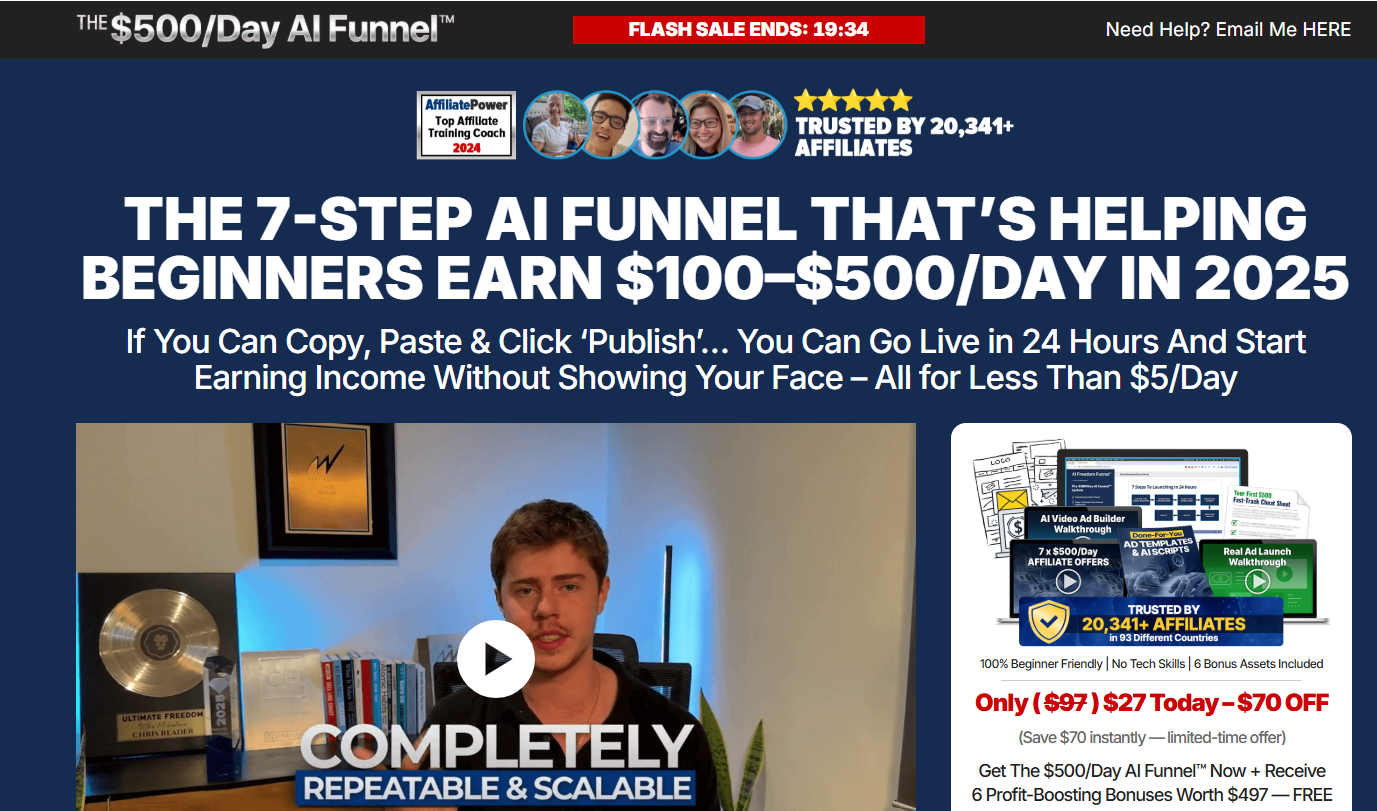
At a high level, The 500 Funnel is a low-ticket training + template bundle that teaches you how to:
- Pick from a set of pre-vetted affiliate offers
- Plug in done-for-you funnel pages
- Use AI prompts to create faceless YouTube ads
- Drive traffic on YouTube for around $5/day
- Scale campaigns that work towards $100–$500+/day in commissions
The legal pages reference Profit Enterprise Pty Ltd as the company behind it, and the site includes standard privacy policy, terms and earnings disclaimers.
There’s a 30-day “Launch Success Guarantee”: if you’re not happy, you can ask for a refund within 30 days and supposedly keep the materials.
What’s notably not clear:
- Who exactly the main creator is, beyond some references to “Chris” in the training description
- Any hard stats on what the average buyer achieves in terms of ROI or earnings
- Transparent case studies with verifiable identity and ad accounts
That doesn’t automatically make it shady, but it does mean you’re relying heavily on the sales copy.
👉 This business model is more reliable!
What Do You Actually Get Inside?
From the sales page, here’s what’s included when you buy:
Core 7-Step Training
- Activate your funnel resources – access to training, templates and assets.
- Choose a high-converting affiliate offer – they give you 7 pre-selected offers that are already proven in their ecosystem.
- Plug in your funnel pages – pre-built landing pages you copy/paste into your funnel builder.
- Use AI script prompts – prompts for generating your video ad script without writing from scratch.
- Build a faceless YouTube ad – using free tools, AI voiceovers and stock visuals, no camera needed.
- Go live and start getting traffic – launching your first campaign, typically on a small budget.
- Scale with a 3x Ad Scaling Formula – their approach for pushing from low-spend testing to higher daily budgets.
Included Bonuses
- Done-for-you ad templates & AI scripts
- Pre-built affiliate funnel pages (compatible with low-cost tools)
- 7 x “$500/day” affiliate offers with angle/positioning notes
- AI video ad builder walkthrough
- “First $500” fast-track cheat sheet
-
Real ad launch walkthrough (watch them set up a fresh campaign)
All of that for a promotional price of $27 (down from a claimed list price of $97) with an ever-present countdown timer urging you to act quickly.
On paper, if you’re already planning to run YouTube affiliate campaigns, this is a small price for a look at someone else’s process.
The real question is whether this setup is actually suitable – or realistic – for a cold beginner with limited budget.
Want a better way to earn?👉 This is the best online business model I’ve found
How The 500 Funnel Says You’ll Make Money
The basic money-flow looks like this:
- You buy the funnel system for $27.
- You pick one of their pre-approved affiliate offers in a proven niche (health, wealth, etc.).
- You set up the pre-built landing pages, usually a simple VSL or bridge page.
- You use their AI prompts to create a faceless YouTube ad.
- You run that ad on YouTube Ads, sending traffic to your funnel.
- A small percentage of viewers click through and buy the offer.
- You earn affiliate commissions on each sale.
In theory, once you have a winning combination of offer + funnel + ad creative + targeting, you simply:
- Increase ad spend
- Make more revenue than you spend on ads
- Pocket the difference as profit
This is performance-based affiliate marketing with paid traffic, wrapped in a low-ticket “system” to make it feel plug-and-play.
The idea is not crazy. Paid ads to affiliate offers can work. I’ve done paid traffic myself, and I’ve known marketers who’ve had multi-six-figure months with this model.
But that’s only half the story.
The Good Stuff (There Are Some Positives)
To be fair, there are a few things I like in principle:
- It’s honest about using paid traffic. They’re not pretending this is “free traffic forever” or some magical social media hack. It’s clearly YouTube ads.
- The price is low. At $27, the product itself isn’t the financial risk – your ad budget is.
- It gives beginners a concrete starting point. If you’ve been stuck in analysis paralysis, having templates, offers and examples can help you launch something.
- The structure is sound in theory. A tight funnel, direct-response YouTube ad and proven offers is a legit combo if you know what you’re doing.
If you’re already familiar with ads and just want to see how another experienced affiliate structures their funnels and creatives, it could be cheap insight.
The problem is the way it’s framed to complete beginners.
👉 This is a better online business for beginners
Red Flags & Concerns You Should Know About
1. New site, no independent track record yet
The domain behind this funnel is very new, and at the time of writing there are essentially no real user reviews on independent review sites – just the platform’s own testimonials and social proof.
That doesn’t prove anything sinister, but when a product is promoted as if it’s responsible for hundreds of millions in student sales and “thousands” of users, you’d expect more independent chatter than a fresh domain and a wall of in-house screenshots.
This isn’t the only program promising faceless, automated income using AI. If you’ve seen Viral Faceless AI Creator, you’ll notice it relies on the same style of “plug-and-play” marketing — simple on the surface, but heavily dependent on paid traffic underneath.
It suggests the sales story is built more on the creator’s broader affiliate history than on this specific $27 funnel.
2. The $364M+ sales claim is vague
The sales page prominently features a ClickBank letter claiming that students have generated $364M+ in affiliate sales with this system.
What’s not clear:
- How many of those sales came directly from this exact $500/Day AI Funnel, vs other programs or coaching
- Over what timeframe that number was accumulated
- Whether that figure includes a small number of top super-affiliates rather than typical beginners
Large aggregate numbers make great copy, but they tell you nothing about the median or average user outcome – which is what actually matters if you’re a normal person with a limited budget.
3. “Beginner-friendly” vs the reality of paid ads
The copy strongly implies you can:
- Launch in 24 hours
- Start at $5/day
- Follow a few steps
- And be on your way to $100–$500/day fairly quickly
Here’s the reality from someone who’s been around this stuff a long time:
- Most beginners will lose money at first while they learn how to test creatives, angles and targeting.
- $5/day is fine for collecting data, but you’re unlikely to hit meaningful income before you’ve spent a few hundred dollars at minimum.
- To consistently make $100–$500/day profit, you generally need a much larger daily ad budget, plus a system for constantly refreshing creatives.
I’ve got a close friend who has spent around $9.5 million on YouTube and Facebook ads over the years. He’s not a newbie – he’s a very advanced media buyer. And even he recently stepped back from this kind of model because ad costs have climbed so much that the economics no longer made sense for many offers.
If someone at that level is finding it hard to make the numbers work, you can see the issue for a total beginner with $5–$20/day to play with.
4. Paid traffic risk is heavily glossed over
The page talks a lot about:
- Launching quickly
- Getting cheap clicks
- Scaling to bigger days
What it doesn’t really focus on is:
- Ad account bans and policy changes (especially in “make money” niches)
- Campaigns that never reach profitability, no matter how closely you follow the template
- The cashflow strain of testing multiple ads, offers and audiences
- The mental side of watching money go out every day before any comes back
Paid traffic is an amazing lever once you know what you’re doing. Before that, it’s just a fast way to buy expensive lessons.
5. Classic funnel urgency and “this beats everything else” positioning
The copy positions The 500 Funnel as the smart alternative to:
- Amazon FBA
- Dropshipping
- Crypto and day trading
- Ecom stores
- Kindle publishing
- Content creation and influencer marketing
There are valid criticisms of all of those models – I agree with many of them.
But any system that claims to beat all other methods by a wide margin, while being cheaper, faster and easier, should automatically trigger your scepticism.
The truth is simple:
- Every model has trade-offs.
- Paid YouTube affiliate funnels are not magically exempt from those trade-offs.
- If this were as close to a sure thing as implied, it wouldn’t be sold for $27 to total beginners.
Who Might The 500 Funnel Suit?
I can see it being potentially useful for a small subset of people:
- You already understand affiliate marketing basics and know how offers, EPCs and conversion rates work.
- You’ve got at least a few hundred dollars you’re genuinely willing to lose while testing ads.
- You want a shortcut to see a working YouTube funnel structure and ad scripts from someone with deeper experience.
- You treat the $27 as paying for a peek behind the curtain, not a ticket to guaranteed profits.
In that context, it’s basically a cheap mini-course plus templates. Nothing wrong with that, as long as your expectations are grounded.
Who I Wouldn’t Recommend It To
I would be very cautious if:
- You’re a complete beginner who’s never built a funnel or run an ad before.
- You’re already stressed about money and can’t comfortably afford to lose ad spend.
- You’re hoping this will replace your job or bills in a few weeks or months.
- You’ve already been burned by other “$100/day in 30 days” style systems.
In those situations, you’re better off avoiding paid-traffic-heavy models altogether until your financial baseline is stronger and you’ve built some skills with lower-risk models.
👉 Try this lower risk model instead
The Bigger Picture: Is This a Real Online Business?
Can you build a real business with paid affiliate funnels?
Yes – but in practice, what most people end up building is:
- Someone else’s customer base (the product owner’s)
- On someone else’s platform (YouTube/Google)
- With someone else’s offer (the affiliate program)
You own the ad account, but you don’t own the offer, the buyers or the checkout. If:
- The offer owner changes payout terms
- The niche gets more competitive
- Your ad account gets restricted
-
Traffic costs climb
…your “business” can disappear very quickly.
That’s fine if you treat it as a cash-flow strategy layered onto something else. It’s a lot more shaky if it’s the only thing you’re doing.
A Better Alternative: Build Assets, Not Just Funnels
Instead of trying to win a YouTube ads arms race against more experienced affiliates, I prefer a model where you’re building digital assets you actually control.
The approach I recommend – and the one I’d do again if I had to start from zero – is local lead generation.
- You build simple, focused two-page websites for local service niches (roofers, landscapers, tree surgeons, etc.).
- You use SEO and/or Google Ads to bring in people actively searching for those services in their area.
- You forward the calls and form leads to a local business, and charge them $500–$2,000/month for the steady flow of customers.
- Once a site ranks and is dialled in, it can run with minimal day-to-day effort, and you can stack multiple sites over time.
You’re not just sending traffic to somebody else’s funnel; you’re owning the property that local businesses depend on.
- No viral content hamster wheel.
- No algorithm roulette on a social platform.
- Much less reliance on constantly changing ad policies in “make money” niches.
If you want to see exactly how that model works in practice – step by step – I break it all down here:
👉 See the best business to start online
Final Verdict – Is The 500 Funnel Worth It?
So, should you buy The 500 Funnel / $500/Day AI Funnel?
My honest view:
- It’s not an outright scam. There is real training, real templates and a structured process.
- The core idea is legitimate – YouTube ads to proven affiliate offers can and do work.
But the sales pitch massively underplays the difficulty and risk of paid traffic, and leans hard on big aggregate numbers that don’t tell you what a typical beginner will experience.
If you’re a beginner looking for your first real online income stream, I wouldn’t make this your main plan.
After 15+ years of testing different models, the one I trust most for that – and the one I’d pick if I had to start over – is the local lead generation model I mentioned above.
Want to see how it works?👉 See the best business to start online

Mark is the founder of MarksInsights and has spent 15+ years testing online business programs and tools. He focuses on honest, experience-based reviews that help people avoid scams and find real, sustainable ways to make money online.