
Hey, it’s Mark from MarksInsights.
If you’re reading this, you’ve probably already seen the Website Factories ads promising things like $8,000–$10,000 per day and “100+ new website customers per day” just by selling a handful of reusable website templates on autopilot.
No client calls. No content. Just Stripe notifications and “faceless” ads doing the work in the background.
It sounds like the dream upgrade from a stressful agency or freelancing setup. But is it actually legit, or just another over-hyped “secret system” wrapped in big income screenshots?
Quick note before we dive in…
I’ve been testing make-money-online programs for over 15 years and built my own income with a simple, asset-based model (local lead generation).
So as you’re reading this, if you’re already thinking:
“I don’t just want hype. I want something that actually works.”
You can see the exact business model I personally recommend here:
👉 See the best business to start online (I’ll walk you through it on the next page).
Key Takeaways (If You’re in a Hurry)
- Website Factories is a training program from Vince that teaches you how to sell pre-built website templates at scale using paid ads and automated delivery.
- The pitch is that you can sell 100+ sites per day at low prices ($27–$497) and stack upsells, recurring subscriptions and backend services to reach very high daily revenue.
- You get a step-by-step funnel blueprint, ad templates, a niche database and “Website Factory” systems, plus a private community.
- The core idea (productized web design plus upsells) is not totally crazy, but the income claims and speed of results are extremely aggressive and assume strong paid-ads skills and significant ad spend.
- Independent transparency is limited, and overall it looks like a high-hype, high-risk model, especially for beginners.
Verdict in one line: Not an obvious “pay and get nothing” scam, but a very ambitious, paid-traffic-heavy system that is far from beginner-friendly.
If you’d prefer to skip the funnels-and-ads complexity and see the model I actually recommend, you can see the best business to start online and then come back to this review with more context.
Where Website Factories Fits in the “Make Money Online” Landscape
One of the biggest problems in this space is context.
If you’ve been Googling how to make money online, you’ll notice the same patterns:
- Big daily income screenshots.
- “We cracked a new model nobody else is using.”
- Heavy focus on “no clients, no calls, no content.”
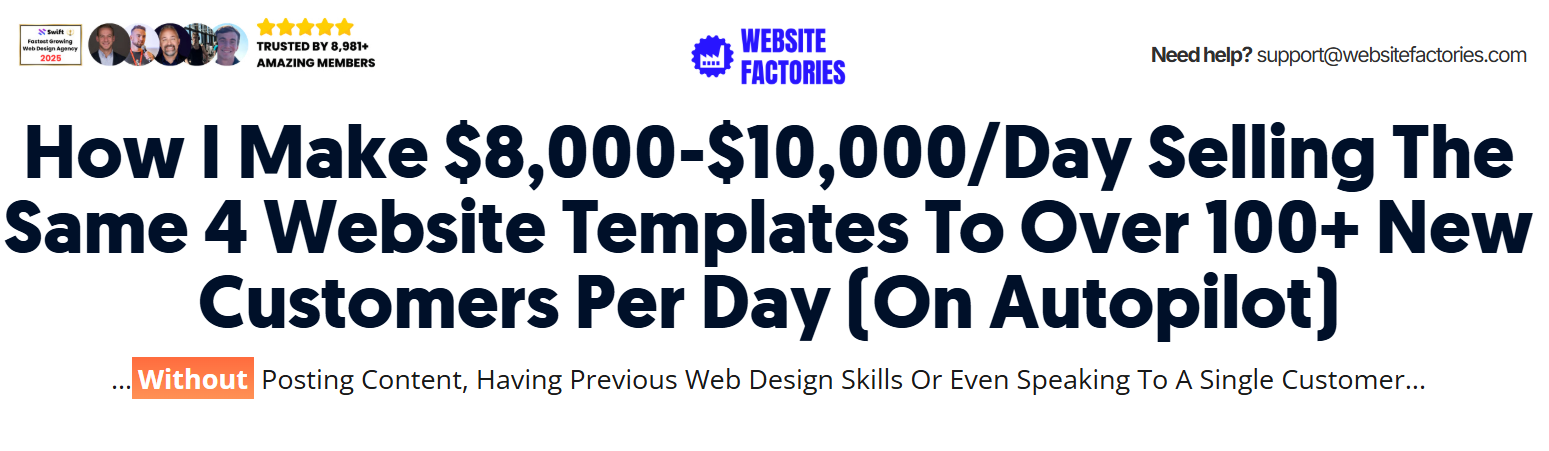 Website Factories sits firmly in that world. It’s positioned as a shortcut compared to starting a traditional agency, freelancing, or learning SEO from scratch.
If you want a grounded overview of what actually works long term (and which models you should treat with caution), it’s worth reading my full How to Make Money Online guide alongside this. It gives you the bigger-picture context that sales pages like this tend to leave out.
What Is Website Factories (In Plain English)?
Stripped of all the marketing, Website Factories is:
A web-design and funnel-building course that shows you how to create a “factory-style” funnel that sells ready-made website templates to small business owners, then upsells them into more expensive services and subscriptions.
The model looks roughly like this:
-
Create or use templates
You pick a niche (plumbers, realtors, coaches, trades, etc.) and either use their supplied templates or build your own using AI and no-code builders. -
Set up a “self-service” funnel
You plug their sales page template into your funnel builder, connect checkout, and set up automated email delivery so the sites are delivered without manual involvement. -
Drive “faceless” traffic with ads
You launch image-based ads (no personal brand required) on platforms like Facebook, and possibly others, using their ad frameworks. -
Stack upsells and recurring revenue
Front end: low-ticket templates.
Back end: marketing bundles, recurring services, communities, consulting or higher-ticket “done-for-you” work.
The promise is that once this is dialled in, you can sell templates at scale while upselling higher-ticket offers in the background.
Conceptually, it’s a productized, ad-driven version of a web-design/service business.
What Do You Actually Get Inside?
Based on the sales page content, here’s what’s included:
Core Training & Blueprint
- “100+ Customers Per Day Blueprint” explaining the full system.
- A detailed case study breaking down a high-revenue “Website Factory.”
- Training on niche selection, pricing, analytics and daily optimisation.
Funnels, Templates & Tools
- A “self-service” sales page template that you customise for your niche.
- Website template blueprints and examples across multiple industries.
- AI workflows for generating website copy and content quickly.
- A toolkit of tools, platforms and resources they recommend for building and scaling.
Paid Traffic & Scaling
- A quick-start ad template to launch campaigns fast.
- Training on cutting losing ads, scaling winners and improving funnel conversion.
- Frameworks for adding upsells, recurring offers and backend products.
Community & Support
- Access to a members’ area and community (they reference member-only events, workshops and Q&A).
- Promised direct support as you implement the system.
On paper, there’s a lot of material here. The question is less “do you get content?” and more “does the model and risk profile make sense for you?”
Red Flags and Concerns You Should Know About
Here’s where I’d slow down and look carefully at the details.
1. Very aggressive income claims
The sales page leans hard on numbers like:
- Up to $8,000–$10,000 per day.
- Factories doing $80,000–$100,000 per week.
- Members hitting tens of thousands per month in what sounds like very short timeframes.
Could those numbers be possible for a tiny percentage of advanced media buyers with large budgets and strong funnels? Maybe.
But framing those results as if they’re a realistic roadmap for the average buyer is, in my experience, very optimistic. Hitting those figures implies:
- Significant monthly ad spend.
- Strong funnel-building and copy skills.
- The ability to handle payment risk, chargebacks and refunds at scale.
Most beginners are nowhere near that starting point.
2. Testimonial-heavy, but hard to verify
The page is stacked with glowing testimonials, star ratings and success stories.
What you don’t see is:
- Clear, verifiable business details for each person.
- Transparent breakdowns of ad spend versus revenue.
- Independent, long-term tracking of results outside the Website Factories ecosystem.
That doesn’t automatically make the testimonials fake, but it does mean you’re being asked to trust a lot of marketing without much neutral evidence.
If you want help spotting these kinds of patterns across different offers, I’ve put together a dedicated Scam Warnings & Red Flags guide that breaks down the common tactics you’ll see repeated in this space.
3. Paid traffic risk is glossed over
The sales pitch talks a lot about:
- Launching ads quickly
- Getting customers for relatively low acquisition costs
- Scaling to dozens or hundreds of buyers per day
What it doesn’t emphasise is:
- Ad account bans and sudden policy changes
- Campaigns that never reach profitability
- The cashflow strain of testing multiple angles, offers and creatives
- The steep learning curve of testing, targeting and tracking
And this isn’t just theory.
A close friend of mine has spent around $9.5 million on Facebook and YouTube ads over the years. He’s not a newbie – he’s an advanced paid ads marketer who used to run big campaigns profitably. But even he eventually walked away from paid traffic because costs kept climbing and the margins were getting squeezed.
He recently tried to get back into it and found the same thing again: ad costs were so high that even with his experience, testing process and tracking dialled in, he couldn’t make the numbers work the way they used to.
That’s someone with years of data, a proven funnel and serious budget behind him.
For beginners, the reality is even harsher. Paid traffic can work, but it is not a plug-and-play shortcut.
4. Classic urgency and FOMO tactics
You’ll see:
- Mentions of “join now before we double the price at X members.”
- Long bonus stacks with inflated “DIY” values.
- A lot of emphasis on speed, scale and “compounding” daily results.
None of that is unique to this offer, but it’s part of a wider pattern: push you into an emotional, time-pressured decision rather than a calm, rational one.
This isn’t the first time I’ve seen a program promise a faceless, automated online income system. If you’ve come across Viral Faceless Creator, you’ll notice it uses the same style of marketing — polished results upfront, but missing the deeper realities of traffic costs and competition.
Is Website Factories a Scam?
In my view:
- It doesn’t look like an outright “pay and get nothing” scam. You appear to get real training, templates and a community.
- The issue is more around expectation setting and risk than complete fraud.
The model they teach can work in principle. Productized web design plus upsells plus recurring revenue is a valid online business.
Where I’m cautious is:
- The gap between the marketing promises and the realistic average outcome.
- The reliance on paid ads and the implied speed of success.
- The lack of independent, verifiable long-term results from regular users.
If you go in, treat it as a high-risk education expense, not a guaranteed income engine.
Who Might Website Factories Suit?
It might be a fit for:
- People who already have experience with paid ads and funnels.
- Existing agency owners who understand their niche and want a productized front-end offer to generate more buyers.
- Entrepreneurs with spare capital who are comfortable testing and possibly losing money upfront while they learn.
It’s not ideal for:
- Complete beginners with no traffic, funnel or copy experience.
- Anyone in a fragile financial position who can’t afford to burn cash on testing.
-
or… People who want steady, low-volatility income rather than high-variance upside.
Pros and Cons
Pros
- Interesting spin on productized web design with upsells and recurring offers.
- Comes with templates, pages and frameworks that could be useful if you already have marketing skills.
- Can potentially act as a strong front-end customer acquisition machine for existing digital businesses.
- Includes community access and ongoing content, which is better than pure “fire-and-forget” launches.
Cons
- Income claims and case studies are very aggressive compared to what most people will realistically achieve.
- Heavy reliance on paid ads and conversion skills.
- Limited independent proof or long-term student success data outside their own marketing.
- Risk of treating it as an “easy mode” shortcut instead of what it is: a complex, high-leverage marketing play.
A Better Alternative
If your main goal is:
-
Replace job income.
-
Build something that compounds.
-
Avoid constant stress around ad performance…
…I don’t think jumping straight into an ad-heavy funnel like this is the best first move.
The approach I recommend (and use myself) is local lead generation with simple two-page sites:
- You build small, focused websites around local services (roofers, landscapers, dentists, trades, etc.).
- You use SEO and, when it makes sense, simple Google Ads to generate leads (calls, form submissions).
- You rent those leads to one business per area for a flat monthly fee, often $500–$2,000 per site.
- Once a site is dialled in, it keeps producing with far less day-to-day work than constantly launching and tweaking high-volume funnels.
You’re still doing real work and building real skills, but:
- You own the digital assets.
- The income is recurring rather than one-off
- You don’t need 100s of new customers
If that sounds more like the kind of business you actually want, you can:
👉 See the best business to start online – I’ll walk you through the full model step by step on the next page.
Final Verdict – Should You Buy Website Factories?
If you’re an experienced marketer with real-world funnel and ad skills, spare testing capital, and a strong reason to bolt this onto an existing business…
…then Website Factories might give you useful ideas, templates and frameworks to experiment with.
But if you’re a beginner looking for your first online income stream, I don’t think this is where you should start.
If you’d rather put your time into something with a clearer path to predictable income, my honest recommendation is to skip Website Factories for now and focus on building a straightforward, asset-based business instead.
👉 Click here to discover my No.1 recommendation – I’ll show you exactly how it works on the next page.

Mark is the founder of MarksInsights and has spent 15+ years testing online business programs and tools. He focuses on honest, experience-based reviews that help people avoid scams and find real, sustainable ways to make money online.